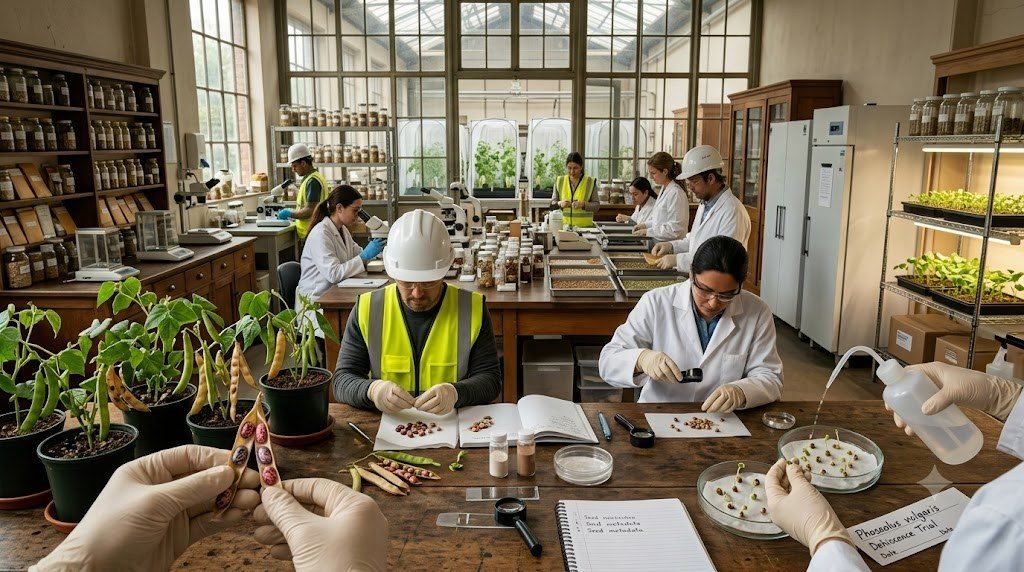
For beginner seed stewards and experienced market growers alike, common garden legumes—including bush and pole beans (Phaseolus vulgaris), cowpeas (Vigna unguiculata), and garden peas (Pisum sativum)—represent the most approachable and rewarding crops for home seed saving. Legumes produce large, easily handled seeds with high food storage reserves, generous seedling vigor, and remarkable genetic stability.
The secret behind the genetic accessibility of legumes lies in their specialized floral anatomy. The classic papilionaceous legume flower functions as an enclosed self-pollination chamber: the reproductive organs (anthers and stigma) are completely enclosed within fused lower petals termed the keel. In the vast majority of bean and pea varieties, anthers dehisce and fertilize the receptive stigma before the flower buds even open to the outside world—a reproductive mechanism termed cleistogamy. Consequently, cross-pollination rates rarely exceed 1% to 3% under standard garden conditions, allowing multiple cultivars to be grown in close proximity with minimal isolation distance.
🌱 Rhizobial Inoculation and Embryo Nitrogen Reserves
Legume seeds establish symbiotic partnerships with soil-dwelling bacteria (Rhizobium leguminosarum for peas; Rhizobium phaseoli for common beans). These bacteria infect root hairs, forming root nodules that convert atmospheric nitrogen (N2) into plant-available ammonium. A mother bean plant provided with robust rhizobial colonization partitions significantly higher concentrations of storage proteins (globulins and albumins) into its developing seed embryos, yielding seedlings with superior root-emergence vigor and early-season drought tolerance.
The Dry Seed Processing Workflow for Legumes
Unlike fleshy fruits that demand wet fermentation, beans and peas are classified as dry-seeded crops. The seed harvesting and curing workflow relies on complete physiological dehydration on the vine:
| Dehydration Phase | Physical Pod Presentation | Seed Moisture Level | Agronomic Action |
|---|---|---|---|
| Green Mature Pod | Pod plump, green, succulent; seeds full size. | 60% – 70% moisture. | Edible table harvest window; do NOT harvest for seed saving (immature embryos). |
| Buckskin Color Break | Pod turns yellow/brown; leathery to touch. | 30% – 40% moisture. | Cut whole plants if heavy autumn frosts or soaking rains threaten. |
| Field-Dry Parchment | Pod brittle, straw-colored; seeds rattle inside. | 12% – 14% moisture. | Hand-pick dry pods on a warm sunny afternoon; pod crackles when squeezed. |
| Post-Thresh Curing | Shelled seeds spread in single layer in warm room. | < 10% moisture. | Seeds pass the ‘thumbnail dent test’: pressing a thumbnail into seed coat leaves zero mark. |
Controlling the Bean Weevil (Acanthoscelides obtectus)
The single greatest biological threat to saved legume seeds in storage is the common bean weevil (Acanthoscelides obtectus). Adult female weevils lay microscopic eggs on maturing bean pods in the field. Upon hatching, the tiny larvae bore invisibly into developing seeds, feeding on the nutrient-rich cotyledons before pupating. Weeks or months after seeds are sealed inside storage jars, adult beetles emerge through neat, circular exit holes, destroying the seed embryo and turning entire seed lots into powdery dust.
To eliminate bean weevil infestations without chemical fumigants, seed stewards utilize a simple, non-toxic physical protocol: deep freezing. Once legume seeds have reached the field-dry stage (moisture content < 10%), pack the seeds into airtight glass mason jars and place them in a standard household freezer (-18°C / 0°F) for 48 to 72 hours. The sub-zero temperatures kill all weevil life stages—eggs, larvae, pupae, and adults—without harming seed germination viability.
Cleistogamy and the Micro-Biomechanics of Bean Flower Self-Fertilization
The floral architecture of the Fabaceae family is a masterpiece of reproductive specialization. The flower consists of five petals: a large erect banner (standard) petal, two lateral wing petals, and two lower petals fused along their ventral margin to form the keel. Inside this boat-shaped keel lie the ten diadelphous stamens (nine fused filaments surrounding one free stamen) and the single carpel with its curved style and receptive stigma.
In common beans (Phaseolus vulgaris) and garden peas (Pisum sativum), the anther sacs rupture and discharge sticky pollen grains directly onto the receptive stigma while the flower is still in the tightly closed bud stage (anthesis before bud opening, termed cleistogamy). By the time the banner petal expands and the flower displays its showy white, pink, or purple colors, fertilization is already complete and the diploid zygote has begun its initial cell divisions. This physiological reality guarantees that cross-pollination rates under natural conditions remain exceptionally low (typically 0.5% to 2.0%), allowing seed stewards to preserve dozens of rare bean heirlooms in relatively compact garden spaces.
🌱 The Runner Bean Exception: Phaseolus coccineus
While common beans (P. vulgaris) are self-fertile cleistogamous inbreeders, scarlet runner beans (Phaseolus coccineus) are obligate outcrossers! Runner bean flowers have an internal tripping mechanism that requires large bumblebees to depress the keel petal, releasing the coiled style to strike the bee’s abdomen. Runner beans cross-pollinate with extreme vigor across 400 to 800 meters and require strict physical caging or massive isolation buffers.
Symbiotic Nodulation and Leghemoglobin Embryo Nutrition
The chemical quality and longevity of legume seeds are directly tied to soil microbiology. When roots are colonized by host-specific Rhizobium bacteria, plant-bacterial communication triggers the expression of nodulin genes, forming specialized root nodules. Inside these nodules, the enzyme nitrogenase breaks the triple covalent bonds of atmospheric dinitrogen (N≡N), converting it into bio-available ammonia (NH3).
To protect the oxygen-sensitive nitrogenase enzyme from irreversible oxidation, the nodule synthesizes leghemoglobin—an iron-bearing plant protein chemically homologous to human hemoglobin that buffers oxygen concentrations. A bean plant with active, pink-centered nodules partitions up to 35% of its total fixed nitrogen directly into embryonic storage globulins (phaseolin in beans; vicilin and legumin in peas). These massive protein reserves provide emerging seedlings with self-contained nutrient power during their first 14 days of growth before root nodulation commences.
Threshing Mechanics, Screen Separation, and the Freeze Protocol
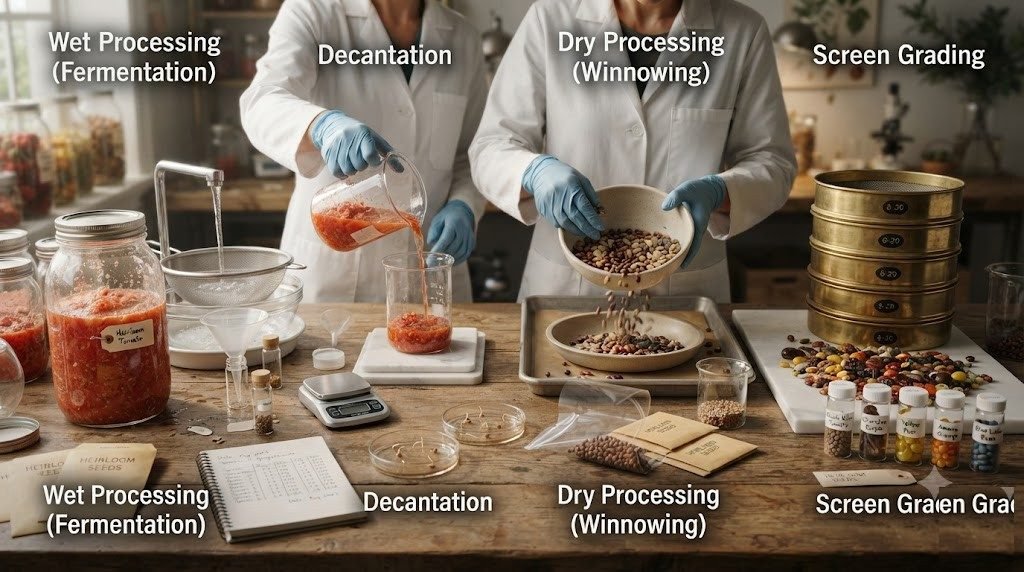
Harvesting legume seed lots requires simple mechanical threshing. Fully dried, brittle pods are loaded inside breathable burlap sacks or canvas duffel bags. The operator gently treads on the sacks or flails them with a lightweight wooden paddle; the brittle pod carpels shatter instantly, releasing smooth seeds into the sack base. Seeds are poured through a two-stage brass seed screen: the top screen catches coarse pod fragments while letting seeds pass, and the bottom fine screen retains clean seeds while allowing fine dust and shattered pod debris to fall through.
Regulatory Standards, ISTA Protocols, and Seed Certification
The commercial distribution and genetic conservation of vegetable seed stocks are governed by comprehensive international and national legal standards. In the United States, the Federal Seed Act (7 U.S.C. 1551) and individual state seed laws enforce minimum germination standards, noxious weed seed tolerances, and varietal trueness labeling. Internationally, the International Seed Testing Association (ISTA) and the Association of Official Seed Analysts (AOSA) publish standardized laboratory protocols for measuring seed purity, moisture content, and germination percentages.
For commercial certified seed production, seed lots must satisfy rigorous four-tier certification standards established by the Association of Official Seed Certifying Agencies (AOSCA):
- Breeder Seed: The highest genetic tier, directly controlled by the originating plant breeder or university agricultural experiment station, guaranteeing 100% varietal purity.
- Foundation Seed: Produced from breeder seed and maintained by agricultural universities or foundation seed organizations under maximum spatial isolation.
- Registered Seed: The progeny of foundation seed, carefully managed to maintain satisfactory genetic identity and purity for commercial multiplication.
- Certified Seed: The final commercial tier sold to farmers and home growers, certified to meet statutory minimum germination percentages (typically ≥ 75% for cucurbits and legumes; ≥ 80% for tomatoes and brassicas) and zero tolerance for designated noxious weed seeds.
Seed Health, Phytosanitary Testing, and Pathogen Exclusion
Seed-borne plant pathogens—including bacterial canker (Clavibacter in tomatoes), black rot (Xanthomonas campestris in brassicas), and anthracnose (Colletotrichum in beans)—can devastate entire agricultural regions if infected seed lots are shipped across borders. Certified seed laboratories deploy molecular diagnostic testing—including Polymerase Chain Reaction (PCR) assays, enzyme-linked immunosorbent assays (ELISA), and agar plating—to verify that seed lots are certified pathogen-free prior to issuing USDA-APHIS phytosanitary export certificates.
| Crop Family | Primary Seed-Borne Pathogen | Diagnostic Assay | Sanitation / Quarantine Benchmark |
|---|---|---|---|
| Solanaceae (Tomatoes) | Clavibacter michiganensis (Bacterial Canker) | Immunofluorescence / PCR | Zero tolerance; 48-hr fermentation or hot water treatment at 50°C for 25 min. |
| Brassicaceae (Cabbage/Kale) | Xanthomonas campestris (Black Rot) | Liquid plating on mCS20AB media | Zero tolerance; hot water treatment at 50°C (122°F) for 20 minutes. |
| Cucurbitaceae (Melons/Squash) | Acidovorax citrulli (Bacterial Fruit Blotch) | Seedling grow-out PCR assay (30,000 seeds) | Zero visual symptoms in 30,000 seedling greenhouse grow-out test. |
| Fabaceae (Beans/Peas) | Pseudomonas savastanoi (Halo Blight) | Agar dilution plating | Field roguing of infected plants; seed harvest strictly from disease-free fields. |
Technical Frequently Asked Questions (FAQ)
Why is hot water seed treatment recommended for brassica and tomato seeds?
Hot water treatment is a non-chemical thermotherapeutic protocol that eradicates internal and external seed-borne bacterial pathogens (such as bacterial canker, black rot, and bacterial spot) without harming seed viability. Seeds are submerged in precisely calibrated hot water (50°C / 122°F) for 20 to 25 minutes using a thermostatically controlled circulating water bath. The heat penetrates the seed coat, denaturing bacterial proteins while remaining just below the thermal death threshold of the plant embryo. Water temperatures must be monitored with ±0.5°C precision, as higher temperatures kill the embryo and lower temperatures fail to eliminate bacteria.
What is the difference between open-pollinated, heirloom, and F1 hybrid seeds?
Open-pollinated (OP) varieties are pollinated by natural mechanisms (wind, insects, or selfing) and breed true-to-type, producing offspring identical to the parent generation if isolated from crossing. An heirloom is an open-pollinated variety that possesses historic provenance, having been preserved, selected, and handed down through families, ethnic communities, or indigenous tribes for at least 50 years. An F1 hybrid is the first-generation offspring of an intentional cross between two highly inbred parent lines. F1 hybrids exhibit hybrid vigor (heterosis) in their first year, but their saved seeds segregate into genetically unpredictable, inferior wild forms in the second (F2) generation, making them unsuitable for seed saving.
How long do vegetable seeds remain viable in typical home storage?
Seed longevity depends on the botanical crop family and environmental storage conditions. Under standard cool, dark, dry room conditions (20°C and 40% relative humidity): Alliums (onions, leeks) and sweet corn have the shortest lifespan, remaining viable for only 1 to 2 years. Brassicas, carrots, and lettuce maintain good germination for 3 to 4 years. Solanaceous crops (tomatoes, peppers, eggplants), legumes (beans, peas), and cucurbits (squash, melons, cucumbers) are long-lived, routinely retaining high germination for 5 to 6+ years. Placing orthodox seeds in airtight glass jars with desiccants in a sub-zero freezer extends viability to 20 to 40+ years.
How can home seed savers prevent inbreeding depression in cross-pollinated crops?
Cross-pollinating (allogamous) crops—such as corn, cabbage, carrots, and onions—require a genetically diverse breeding population to maintain biological vigor. If a gardener saves seeds from only two or three individual cabbage plants year after year, recessive deleterious mutations accumulate, leading to severe inbreeding depression: stunted growth, reduced yields, loss of heading ability, and poor germination. To preserve genetic vigor, seed savers adhere to minimum population size rules: save seeds from at least 20 to 50 individual mother plants for brassicas and squashes, and at least 100 to 200 individual plants for wind-pollinated sweet corn.
Phaseolin Protein Polymorphism and Seed Storage Protein Density
The primary storage protein synthesized inside developing bean embryos (Phaseolus vulgaris) is phaseolin, a trimeric 7S globulin that accounts for up to 50% of total seed protein. In evolutionary botany, phaseolin exhibits distinct electrophoretic banding patterns that distinguish the two ancient centers of bean domestication: the Mesoamerican gene pool (producing small, dense, black and navy beans) and the Andean gene pool (producing large, plump kidney and cranberry beans).
Because phaseolin is exceptionally stable when dry, properly cured heirloom bean seeds preserve their nutritive and germination vitality across extreme durations. When stored under hermetic, low-moisture conditions, the protein matrix protects embryonic cell organelles from oxidative cleavage, allowing heritage pole and bush beans to maintain robust, rapid germination even after a decade in cool, dark seed banking storage.
Integrating diverse heirloom dry beans into community seed banks also preserves traditional Indigenous Three Sisters polyculture genetics, ensuring that climbing pole beans retain the structural vigor required to ascend corn stalks without lodging.