At the center of all agricultural plant life lies the miracle of seed germination—the physiological transition of a quiescent, dehydrated plant embryo into a metabolically active, rapidly growing seedling. A dry mature seed is an astonishing biological capsule: living cells contain as little as 5% to 10% water, cellular respiration is throttled to near-zero stasis, and cellular membranes are preserved in a vitreous (glassy) sugar-amorphous state that allows the embryo to survive freezing cold and desert drought for years.
When environmental conditions—specifically moisture, thermal energy, oxygen, and appropriate light cues—align, this dormant state is shattered. Germination is not an instantaneous single event, but a highly coordinated, three-phase biochemical and biophysical cascade termed the triphasic pattern of seed water uptake.
🌱 The Three Phases of Seed Imbibition
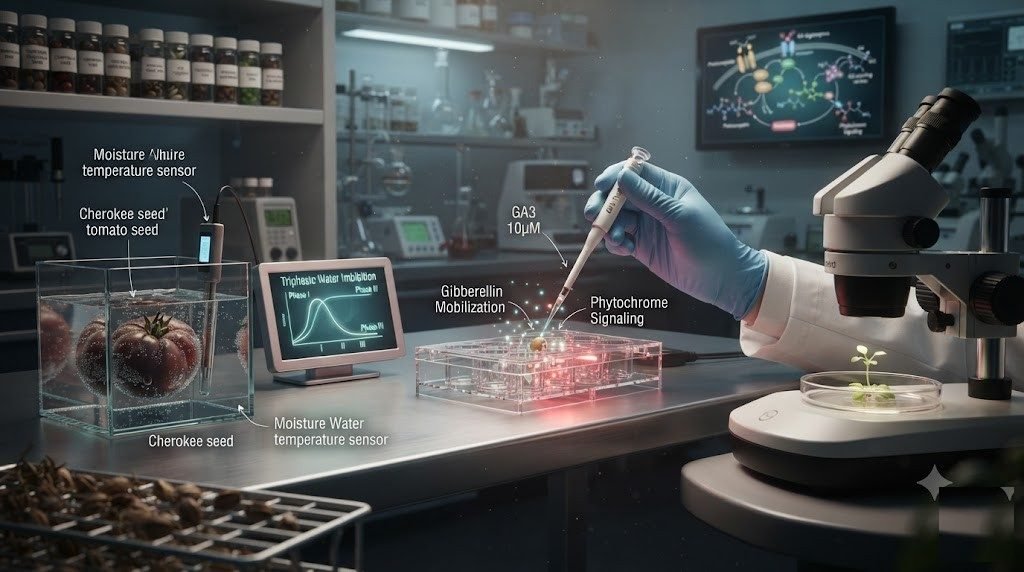
Phase I (Rapid Physical Imbibition) is driven by matric water potential: dry seed colloids (proteins, starches, cell walls) pull in water passively in hours, causing the seed to swell. Phase II (The Metabolic Lag Phase) exhibits stable plateaued water content: living cells reactivate mitochondria, repair DNA damaged during dry storage, and synthesize new mRNA and enzymes. Phase III (Radicle Protrusion) marks the irreversible expansion of radicle cells powered by osmotic turgor pressure, officially concluding germination.
The Hormonal Tug-of-War: Abscisic Acid (ABA) vs. Gibberellins (GA)
The molecular switch governing seed dormancy and germination is controlled by an antagonistic hormonal rheostat between two key phytohormones:
| Phytohormone | Biochemical Role in Seed | Environmental & Internal Triggers | Cellular Action in Germination |
|---|---|---|---|
| Abscisic Acid (ABA) | Dormancy inducer and maintenance enforcer; inhibits germination. | Synthesized during maternal seed maturation and drought stress. | Blocks transcription of alpha-amylase and hydrolase genes; stabilizes dormancy. |
| Gibberellic Acid (GA) | Dormancy terminator and germination activator. | Triggered by cold chilling (stratification), light cues, and imbibition. | Diffuses to the aleurone layer, activating genes that produce starch-digesting enzymes. |
| Ethylene (C2H4) | Secondary germination promoter and dormancy co-breaker. | Upregulated in response to soil nitrate and microbial cues. | Enhances radicle elongation and counteracts residual ABA inhibition in embryo cells. |
The Phytochrome Light-Sensing Photoreceptor Switch
In photoblastic seeds that require light to germinate (such as lettuce, celery, and many fine flowers), germination is triggered by a pigment protein known as phytochrome. Phytochrome exists in two interconvertible conformational states:
- Pr (Red-Absorbing Form): The inactive state that absorbs red light (wavelength ~660 nm), converting rapidly into the active Pfr form.
- Pfr (Far-Red-Absorbing Form): The active biological trigger that absorbs far-red light (~730 nm), reverting back to the inactive Pr form in darkness.
Direct sunlight contains a high ratio of red to far-red light (approx. 1.2 : 1), driving phytochrome into the active Pfr state, which immediately signals the embryo to synthesize gibberellins and begin growth. Conversely, when a seed is shaded under a dense forest canopy or buried deep in soil, the red light is filtered out by green leaf chlorophyll, leaving an excess of far-red light that inactivates phytochrome (Pr), preventing the seed from germinating in fatal darkness.
The Biophysics of Matric Water Potential and Phase I Imbibition
The initial phase of seed water uptake (Phase I) is a purely physical biophysical process driven by extreme differences in water potential (Ψ). A dry orthodox seed possesses a matrix water potential as low as -50 to -100 megapascals (MPa), compared to moist soil which typically ranges from -0.01 to -0.05 MPa. This colossal thermodynamic gradient pulls liquid water into the seed through microscopic fissures in the seed coat and the micropylar pore.
As water rushes into dehydrated cells, dry hydrophilic macromolecules—including seed storage proteins (globulins and prolamins), starch grains, and cell-wall pectic polysaccharides—hydrate rapidly, releasing heat (the heat of wetting). Cell volume expands by 50% to 200%. However, this rapid influx of water causes transient membrane leakage: the phospholipid bilayer, which was locked in a rigid gel phase in the dry seed, undergoes a phase transition to a fluid liquid-crystalline state, temporarily leaking amino acids, sugars, and electrolytes into the surrounding soil before membrane repair complexes seal the cell walls.
🌱 Phase II: Mitochondrial Respiration Reactivation and DNA Repair
During Phase II (the metabolic lag phase), water uptake plateaus. Inside living cells, profound biochemical repair occurs: pre-existing mitochondria reactivate and begin oxidative phosphorylation, generating ATP to power cellular metabolism. Repair enzymes—including DNA ligases and poly(ADP-ribose) polymerases—scan the genome, repairing double-strand DNA breaks accumulated during years of dry storage. If a seed is too old or damaged by heat, these repair mechanisms fail, ATP synthesis halts, and the seed dies in Phase II without ever reaching radicle emergence.
The Aleurone Layer and De Novo Alpha-Amylase Synthesis
Once Phase II cellular repair is accomplished, the embryo synthesizes active gibberellins (GA) that diffuse across to the specialized outer tissue of the endosperm termed the aleurone layer. In aleurone cells, gibberellin binds to GID1 receptors, derepressing transcription of the α-amylase gene.
Aleurone cells synthesize and secrete massive quantities of hydrolytic enzymes—principally α-amylase, β-amylase, and proteases—into the central starchy endosperm. These enzymes hydrolyze insoluble starch granules into soluble maltose and glucose, which are transported to the growing radicle tip and plumule, providing the biochemical fuel and osmotic solutes needed to drive rapid cell elongation and radicle protrusion through the seed coat (Phase III).
International Seed Testing Rules (ISTA / AOSA) and Genebank Protocols
The scientific discipline of seed preservation and quality assessment is codified globally by two preeminent organizations: the International Seed Testing Association (ISTA) and the Association of Official Seed Analysts (AOSA). These bodies establish precise, legally binding laboratory testing protocols governing working sample sizes, seed purity determination, moisture meters calibration, and standard germination testing conditions (including specific substrate media, diurnal temperature cycles, and first/final seedling evaluation counts). In long-term ex situ genetic conservation, public genebanks—such as the USDA National Center for Genetic Resources Preservation (NCGRP) and the Millennium Seed Bank at Kew—adhere to the FAO Genebank Standards for Plant Genetic Resources for Food and Agriculture.
The FAO Genebank Standards define exact operational criteria for preserving orthodox crop germplasm:
- Accession Regeneration Triggers: A seed accession stored in a base collection must undergo field regeneration whenever viability drops below 85% of its initial storage baseline, or when total seed inventory falls below 1,500 viable seeds.
- Moisture Equilibrium Standards: Seeds must be desiccated in humidity-controlled drying rooms (15°C and 15% relative humidity) until internal seed moisture content reaches equilibrium between 3% and 7% depending on seed lipid composition.
- Storage Thermal Regime: Base collections destined for multi-decade conservation must be stored in hermetically sealed moisture-proof containers at -18°C ± 2°C (0°F) with an internal relative humidity of 15% ± 3%.
Orthodox, Intermediate, and Recalcitrant Seed Longevity Classifications
In seed preservation biology, plant species are categorized into three distinct physiological storage classifications that dictate their preservation feasibility:
| Storage Physiology Class | Desiccation Tolerance Limit | Freezer Survivability (-18°C) | Representative Plant Families & Crops |
|---|---|---|---|
| Orthodox Seeds | Tolerates extreme dehydration down to 3% – 7% moisture. | Survives sub-zero freezing for decades with zero tissue rupture. | 90%+ of agricultural crops: Solanaceae (Tomatoes), Brassicaceae, Cucurbits, Fabaceae. |
| Intermediate Seeds | Tolerates drying to 10% – 15% moisture; damaged by severe drying. | Sensitive to sub-zero freezing; loses viability rapidly below -5°C. | Citrus species, Coffee (Coffea arabica), Papaya, Neem, certain tropical palms. |
| Recalcitrant Seeds | Intolerant of desiccation; cell death occurs below 30% – 40% moisture. | Killed instantly by freezing temperatures (intracellular ice crystals). | Tropical rainforest trees, Avocados, Mangoes, Cacao, Oaks (Acorns), Chestnuts. |
Technical Frequently Asked Questions (FAQ)
What is Harrington’s Rule of seed storage, and how does it predict seed lifespan?
Formulated by seed physiologist Dr. James F. Harrington, Harrington’s Rules are empirical principles that quantify the mathematical relationship between environmental conditions and orthodox seed longevity: Rule 1: For every 1% reduction in seed moisture content (between 5% and 14%), the potential storage lifespan of the seed doubles! Rule 2: For every 5°C (10°F) reduction in storage temperature (between 0°C and 50°C), the potential storage lifespan of the seed doubles! Combining low moisture (5% to 7%) with freezer temperatures (-18°C) produces a multiplicative exponential lifespan extension, allowing orthodox seeds to survive for decades.
How does the biochemical Tetrazolium (TZ) test determine seed viability in hours?
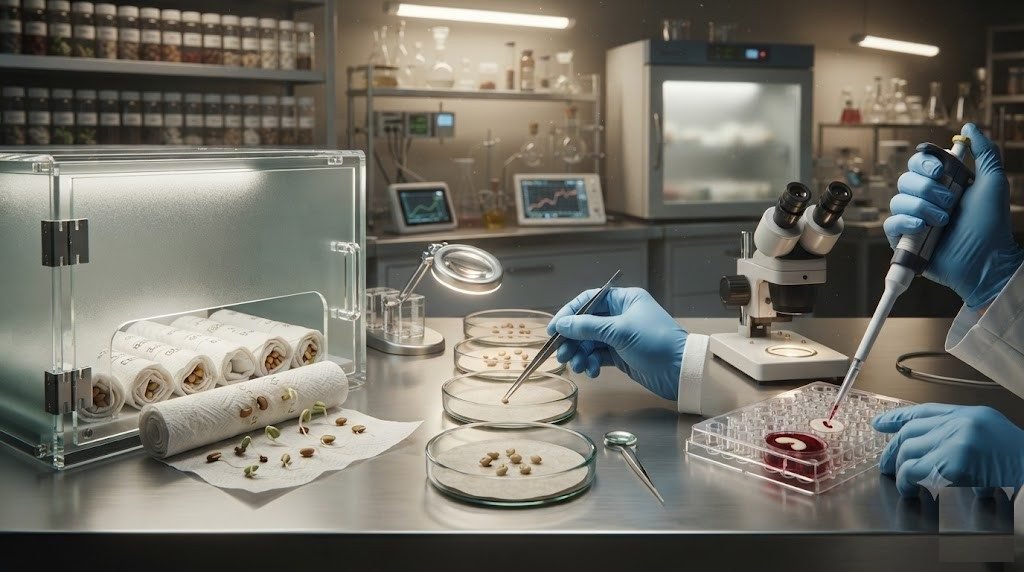
The Tetrazolium test (2,3,5-triphenyl tetrazolium chloride) is an enzymatic assay of cellular respiration. When a dormant or non-germinated seed is cut in half and soaked in a clear 1% tetrazolium solution, active respiratory dehydrogenase enzymes inside living cells release hydrogen ions. These ions chemically reduce the colorless salt into an insoluble, vivid red dye called formazan, staining living embryonic tissues bright carmine red. Dead or decayed tissues lack active respiratory enzymes and remain uncolored or ghostly white, providing definitive viability confirmation in just 2 to 4 hours without waiting weeks for seedlings to sprout.
Why is winnowing effective at separating viable seeds from hollow hulls and chaff?
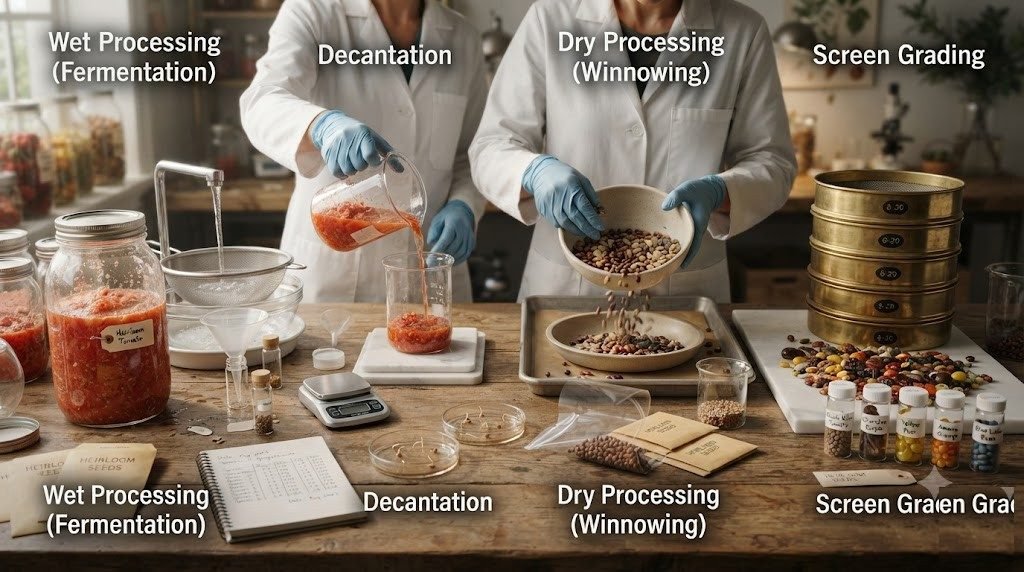
Winnowing relies on the aerodynamic principle of terminal settling velocity. When a mixture of harvested seeds and crushed plant chaff is dropped through a horizontal air current (from an electric fan or natural breeze), aerodynamic drag acts upon the surface area of each particle while gravity pulls its mass downward. Dried chaff, pod fragments, and hollow unpollinated seeds have high surface area relative to their lightweight mass, giving them a very low terminal velocity that allows moving air to carry them away horizontally. Dense, embryo-filled viable seeds have high mass relative to surface area and fall straight down into the collection container.
What is the difference between seed germination capacity and seedling vigor?
Germination capacity is the total percentage of seeds that push a radical under ideal, controlled laboratory conditions (optimal temperature, sterile moist blotter, perfect humidity). Seedling vigor is the physiological capability of those emerging seedlings to perform under real-world garden stress: pushing through crusted soil, tolerating cold spring rain, resisting soil-borne damping-off fungi, and establishing vigorous root systems. Old or poorly stored seeds may still demonstrate 75% germination capacity on a warm moist paper towel in a laboratory, but exhibit near-zero field vigor, emerging as stunted, weak seedlings that quickly die in garden beds.
Reactive Oxygen Species (ROS) as Dual-Action Germination Mediators
In classical seed biology, Reactive Oxygen Species (ROS)—including superoxide radicals (O2•-) and hydrogen peroxide (H2O2)—were viewed strictly as toxic, damaging byproducts of aerobic cellular metabolism that cause oxidative stress and seed aging. However, modern plant physiological research has revealed that during seed germination, ROS act as vital, beneficial signaling messengers within a tightly regulated concentration window termed the ‘oxidative window for germination’.
During Phase II metabolic lag, controlled bursts of hydrogen peroxide produced by cell-wall NADPH oxidases serve two essential developmental functions: they oxidize and inactivate specific proteins that enforce dormancy (including direct chemical degradation of abscisic acid), while reacting with cell-wall polysaccharides to cleave covalent bonds, directly softening and loosening the micropylar endosperm so the radicle can emerge. Only when ROS concentrations exceed antioxidant defenses (catalase and superoxide dismutase) does cellular damage occur.
Epigenetic Histone Acetylation in Germination Transcription
The awakening of a dehydrated seed embryo involves massive remodeling of chromatin architecture. In the dry dormant seed, chromosomal DNA is tightly coiled around histone proteins, silencing metabolic and developmental genes. Upon imbibition, histone acetyltransferase (HAT) enzymes add acetyl groups to lysine residues on histone tails, neutralizing their positive charge and causing the tightly packed chromatin to relax into an open, accessible euchromatin configuration.
This epigenetic remodeling allows RNA polymerase II complexes to bind freely to promoter regions of thousands of germination-specific genes, initiating the rapid transcription of ribosomal RNA, translation factors, and enzymes that drive cellular division and organogenesis in the emerging seedling.
Understanding these cellular switches enables seed scientists to develop targeted, non-chemical seed priming protocols—such as hydro-priming and bio-osmopriming—that accelerate field emergence and enhance crop stand uniformity under challenging saline or drought-stressed soils. High-resolution confocal laser scanning microscopy confirms that primed seeds initiate mitochondrial ATP synthesis within minutes of soil contact, establishing robust root anchors before competing weed seeds can emerge. By fine-tuning the delicate hormonal equilibrium between abscisic acid breakdown and gibberellic acid synthesis, growers achieve synchronized, high-density crop emergence even under fluctuating early-spring temperatures.