From the world’s premier crop conservation vault—the Svalbard Global Seed Vault buried deep inside Arctic permafrost—to a small mason jar resting inside a backyard homesteader’s freezer, the underlying scientific principles of long-term seed preservation remain fundamentally identical. The objective of seed banking is to slow down the relentless thermodynamic and biochemical processes of cellular aging, enzyme degradation, and DNA fragmentation, preserving living plant embryos in a state of suspended animation for decades or centuries.
The vast majority of agricultural food crops—including grains, brassicas, solanaceous vegetables, legumes, and cucurbits—produce orthodox seeds. Orthodox seeds possess the remarkable evolutionary capability to tolerate dehydration down to 5% to 7% moisture content and survive sub-freezing temperatures without ice crystal tissue rupture.
🌱 Harrington’s Two Golden Rules of Seed Storage
Formulated by legendary seed physiologist Dr. James F. Harrington, these empirical rules define seed longevity: Rule 1: For every 1% reduction in seed moisture content (between 5% and 14%), the storage lifespan of the seed doubles! Rule 2: For every 5°C (10°F) drop in storage temperature (between 0°C and 50°C), the storage lifespan of the seed doubles! Combining low moisture with freezing temperatures multiplies seed lifespan exponentially.
The Critical Equilibrium Moisture Content (EMC) and Desiccants
The single most destructive mistake in seed banking is placing freshly harvested seeds into an airtight jar while internal seed moisture remains high (> 12%). Confined inside an airtight container, damp seeds respire actively, producing metabolic heat, carbon dioxide, and condensation that triggers catastrophic fungal mold blooms and suffocates embryos within weeks.
Before sealing seeds into hermetic containers, they must reach Equilibrium Moisture Content (EMC) with an ambient Relative Humidity (RH) of 20% to 30%. This is accomplished by placing seeds in a sealed conditioning chamber alongside food-grade indicating silica gel beads at a 1:1 seed-to-silica weight ratio for 7 to 14 days, monitoring the color change from bright orange to deep green to verify moisture extraction.
Hermetic Packaging and Sub-Zero Freezer Storage Standards
Once seeds have been desiccated to their target moisture band (strictly 5% to 8%), they must be hermetically isolated from atmospheric moisture. Standard paper envelopes and cardboard seed packets are permeable to water vapor and will allow seeds to absorb moisture from the surrounding air within days.
Elite seed banks utilize heat-sealed foil laminate mylar pouches (polyethylene/aluminum/polyester multilayer) or heavy-gauge glass mason jars fitted with airtight rubber ring gaskets. Once sealed, containers are stored in dedicated freezers maintained at -18°C (0°F). Under these sub-zero, moisture-sealed conditions, orthodox seeds of tomatoes, melons, and beans can remain viable and true-to-type for 25 to 50+ years, preserving humanity’s heirloom heritage for future generations.
Thermodynamic Equilibrium Relative Humidity (eRH) and Water Activity (aw)
In modern seed banking science, assessing seed moisture as a percentage of fresh weight is progressively being replaced by measuring Equilibrium Relative Humidity (eRH) and Water Activity (aw). Fresh-weight moisture percentages vary wildly between oily seeds (like sunflowers or flax, where lipids do not bind water) and starchy seeds (like wheat or peas, where starches absorb large amounts of water). A moisture content of 8% represents safe storage for a starchy bean, but is dangerously damp for an oily flax seed!
Water activity measures the chemical energy state (escaping tendency) of water molecules within the seed. For safe long-term conservation, seeds of all botanical families must achieve an equilibrium water activity between aw = 0.20 and 0.30 (20% to 30% eRH). Within this precise thermodynamic window:
- Free water capable of supporting bacterial or fungal spore germination is entirely absent.
- Water molecules form a single, protective monomolecular layer around cellular proteins and membrane phospholipids, preventing lipid auto-oxidation.
- Over-drying seeds below 15% eRH (aw < 0.15) is actively avoided, as extreme desiccation induces structural protein denaturation and lipid radical cascade damage.
🌱 The Physics of Cryopreservation: The Vitrification Glass Transition
At standard seed bank freezer temperatures (-18°C to -20°C), properly dried orthodox seeds do not form ice crystals. Instead, cellular sugars (sucrose and raffinose family oligosaccharides) enter an ultra-viscous, non-crystalline solid state termed the vitreous (glassy) state. In this sugar glass, molecular diffusion drops to near absolute zero: enzymes cannot move, chemical reactions freeze in place, and biological aging halts for decades.
Hermetic Packaging Materials: Mylar Foil Laminates vs. Glass Mason Jars
Once seeds have reached equilibrium moisture (20% – 30% eRH), packaging must guarantee absolute hermetic isolation from atmospheric humidity:
| Packaging Material | Water Vapor Transmission Rate (WVTR) | Gas Permeability Barrier | Long-Term Seed Banking Suitability |
|---|---|---|---|
| Heat-Sealed Mylar Foil Pouch (PET/Alu/PE) | < 0.005 g/m2/24hr (Virtually Zero). | Impermeable to oxygen, nitrogen, and moisture vapor. | The gold standard for genebanks (Svalbard, Kew Millennium Seed Bank). |
| Heavy-Gauge Glass Mason Jar with Rubber Gasket | 0.000 g/m2/24hr (Absolute Zero). | 100% impermeable to gases and moisture. | Ideal for home seed banks and community libraries; transparent (must store in dark). |
| Polyethylene Ziplock Bags (Standard Plastic) | High (> 5.0 g/m2/24hr). | Permeable to water vapor and oxygen over weeks. | UNSUITABLE for long-term storage; seeds absorb ambient humidity within months. |
| Paper Envelopes & Cardboard Packets | Infinite (Zero barrier). | Freely breathes atmospheric moisture and humidity. | Suitable only for short-term active season sowing; fails in humid storage. |
Regenerative Grow-Out Triggers and Accession Management
Even under optimal -18°C hermetic storage, seed viability eventually declines over decades. Standard genebank protocols mandate that an accession must undergo a regenerative field grow-out whenever standard blotter viability assays indicate that germination has dropped to 85% of its initial baseline viability (e.g., if a seed lot started at 95% germination and drops to 80%). Growing out 50 to 100 plants in controlled isolation regenerates thousands of fresh, high-vigor seeds, resetting the conservation countdown for another 30 to 50 years.
International Seed Testing Rules (ISTA / AOSA) and Genebank Protocols
The scientific discipline of seed preservation and quality assessment is codified globally by two preeminent organizations: the International Seed Testing Association (ISTA) and the Association of Official Seed Analysts (AOSA). These bodies establish precise, legally binding laboratory testing protocols governing working sample sizes, seed purity determination, moisture meters calibration, and standard germination testing conditions (including specific substrate media, diurnal temperature cycles, and first/final seedling evaluation counts). In long-term ex situ genetic conservation, public genebanks—such as the USDA National Center for Genetic Resources Preservation (NCGRP) and the Millennium Seed Bank at Kew—adhere to the FAO Genebank Standards for Plant Genetic Resources for Food and Agriculture.
The FAO Genebank Standards define exact operational criteria for preserving orthodox crop germplasm:
- Accession Regeneration Triggers: A seed accession stored in a base collection must undergo field regeneration whenever viability drops below 85% of its initial storage baseline, or when total seed inventory falls below 1,500 viable seeds.
- Moisture Equilibrium Standards: Seeds must be desiccated in humidity-controlled drying rooms (15°C and 15% relative humidity) until internal seed moisture content reaches equilibrium between 3% and 7% depending on seed lipid composition.
- Storage Thermal Regime: Base collections destined for multi-decade conservation must be stored in hermetically sealed moisture-proof containers at -18°C ± 2°C (0°F) with an internal relative humidity of 15% ± 3%.
Orthodox, Intermediate, and Recalcitrant Seed Longevity Classifications
In seed preservation biology, plant species are categorized into three distinct physiological storage classifications that dictate their preservation feasibility:
| Storage Physiology Class | Desiccation Tolerance Limit | Freezer Survivability (-18°C) | Representative Plant Families & Crops |
|---|---|---|---|
| Orthodox Seeds | Tolerates extreme dehydration down to 3% – 7% moisture. | Survives sub-zero freezing for decades with zero tissue rupture. | 90%+ of agricultural crops: Solanaceae (Tomatoes), Brassicaceae, Cucurbits, Fabaceae. |
| Intermediate Seeds | Tolerates drying to 10% – 15% moisture; damaged by severe drying. | Sensitive to sub-zero freezing; loses viability rapidly below -5°C. | Citrus species, Coffee (Coffea arabica), Papaya, Neem, certain tropical palms. |
| Recalcitrant Seeds | Intolerant of desiccation; cell death occurs below 30% – 40% moisture. | Killed instantly by freezing temperatures (intracellular ice crystals). | Tropical rainforest trees, Avocados, Mangoes, Cacao, Oaks (Acorns), Chestnuts. |
Technical Frequently Asked Questions (FAQ)
What is Harrington’s Rule of seed storage, and how does it predict seed lifespan?
Formulated by seed physiologist Dr. James F. Harrington, Harrington’s Rules are empirical principles that quantify the mathematical relationship between environmental conditions and orthodox seed longevity: Rule 1: For every 1% reduction in seed moisture content (between 5% and 14%), the potential storage lifespan of the seed doubles! Rule 2: For every 5°C (10°F) reduction in storage temperature (between 0°C and 50°C), the potential storage lifespan of the seed doubles! Combining low moisture (5% to 7%) with freezer temperatures (-18°C) produces a multiplicative exponential lifespan extension, allowing orthodox seeds to survive for decades.
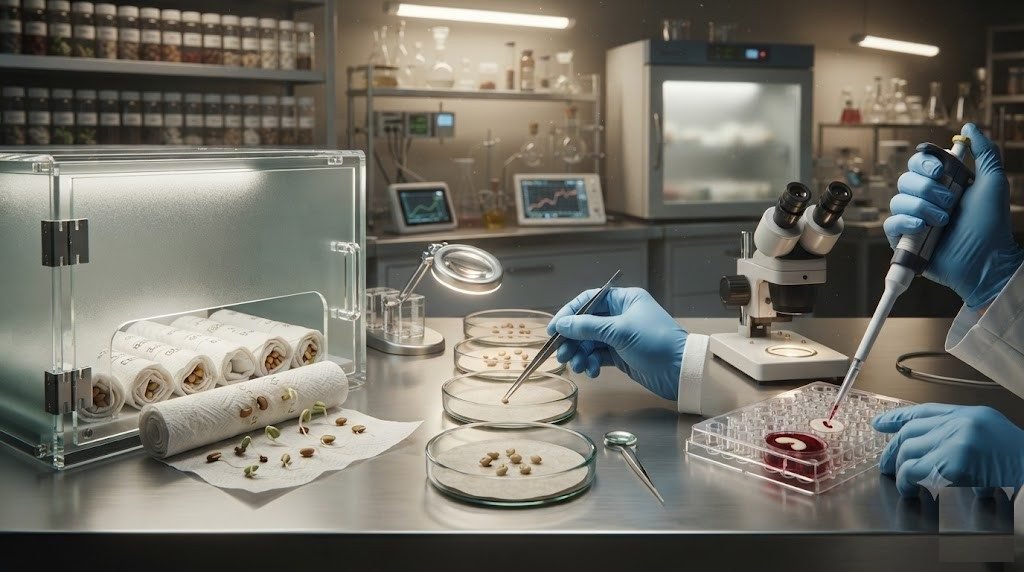
How does the biochemical Tetrazolium (TZ) test determine seed viability in hours?
The Tetrazolium test (2,3,5-triphenyl tetrazolium chloride) is an enzymatic assay of cellular respiration. When a dormant or non-germinated seed is cut in half and soaked in a clear 1% tetrazolium solution, active respiratory dehydrogenase enzymes inside living cells release hydrogen ions. These ions chemically reduce the colorless salt into an insoluble, vivid red dye called formazan, staining living embryonic tissues bright carmine red. Dead or decayed tissues lack active respiratory enzymes and remain uncolored or ghostly white, providing definitive viability confirmation in just 2 to 4 hours without waiting weeks for seedlings to sprout.
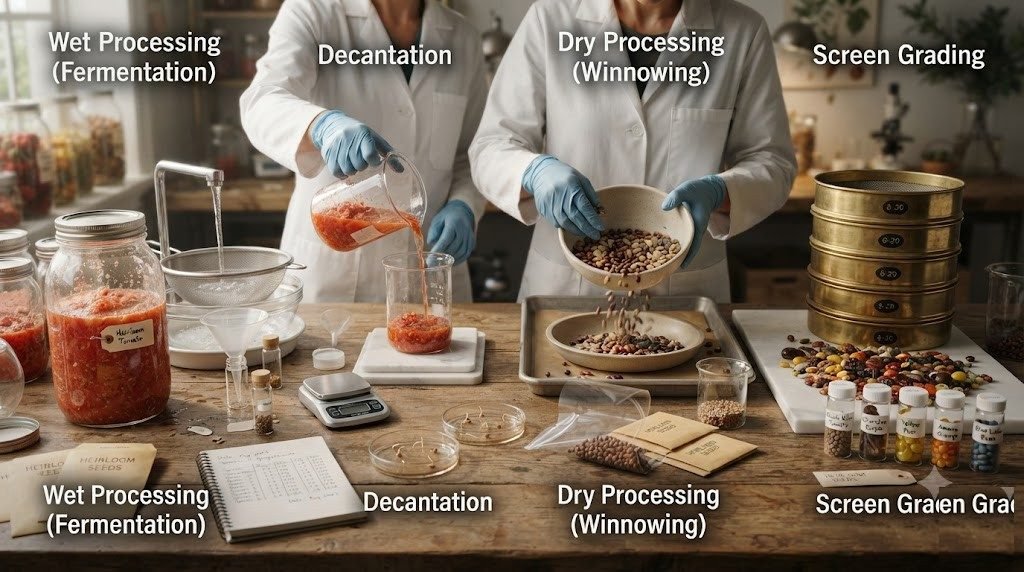
Why is winnowing effective at separating viable seeds from hollow hulls and chaff?
Winnowing relies on the aerodynamic principle of terminal settling velocity. When a mixture of harvested seeds and crushed plant chaff is dropped through a horizontal air current (from an electric fan or natural breeze), aerodynamic drag acts upon the surface area of each particle while gravity pulls its mass downward. Dried chaff, pod fragments, and hollow unpollinated seeds have high surface area relative to their lightweight mass, giving them a very low terminal velocity that allows moving air to carry them away horizontally. Dense, embryo-filled viable seeds have high mass relative to surface area and fall straight down into the collection container.
What is the difference between seed germination capacity and seedling vigor?
Germination capacity is the total percentage of seeds that push a radical under ideal, controlled laboratory conditions (optimal temperature, sterile moist blotter, perfect humidity). Seedling vigor is the physiological capability of those emerging seedlings to perform under real-world garden stress: pushing through crusted soil, tolerating cold spring rain, resisting soil-borne damping-off fungi, and establishing vigorous root systems. Old or poorly stored seeds may still demonstrate 75% germination capacity on a warm moist paper towel in a laboratory, but exhibit near-zero field vigor, emerging as stunted, weak seedlings that quickly die in garden beds.
The Glassy Matrix Physics of Seed Embryo Vitrification
When orthodox seeds are dried to an equilibrium water content of 5% to 7% and cooled to -18°C (0°F), the physical state of the internal cytoplasm undergoes a profound biophysical transition known as vitrification. Instead of water molecules arranging themselves into crystalline ice structures (which would puncture and destroy delicate cellular organelle membranes), the cytoplasm solidifies into a high-viscosity, amorphous solid matrix—a biological ‘sugar glass’ composed of concentrated sucrose, raffinose, stachyose, and LEA (Late Embryogenesis Abundant) protective proteins.
In this vitreous state, molecular mobility drops to near zero: diffusion rates are reduced by orders of magnitude, chemical degradation reactions are effectively immobilized, and metabolic cellular respiration ceases entirely. Living embryos preserved in this glass matrix remain biologically suspended in time, capable of surviving for decades or centuries until re-hydrated at warm temperatures.
Desiccation-Tolerance Thermodynamics and Color-Indicating Silica Desiccants
To dry seeds safely to their target equilibrium moisture content without applying damaging heat (> 35°C), seed banks utilize food-grade indicating silica gel beads. Silica gel is an amorphous form of silicon dioxide possessing an immense internal network of microscopic pores, providing an effective surface area exceeding 700 m2 per gram.
Seeds are sealed inside an airtight glass container with an equal mass of orange-indicating silica gel. As the silica draws water vapor from the air, the seeds release moisture to maintain equilibrium. The non-toxic organic indicator changes from bright orange to dark olive green as it absorbs water. Once the color change halts and relative humidity inside the chamber stabilizes at 20% to 25% (verified by a digital hygrometer), the seeds are immediately transferred to heat-sealed foil mylar pouches and stored in the sub-zero freezer.