Before committing valuable labor, greenhouse bench space, organic compost, and field acreage to sowing a batch of stored seeds, agriculturalists and seed bank curators must answer a vital question: What percentage of these seeds are alive and capable of producing vigorous, healthy seedlings? Relying on unverified, old seed packets can result in catastrophic stand failures, wasted growing seasons, and unrecoverable commercial losses.
In seed technology, seed evaluation is governed by standardized laboratory testing methodologies formalized by the Association of Official Seed Analysts (AOSA) and the International Seed Testing Association (ISTA). Growers utilize three primary viability testing protocols depending on their timeframe and technical resources: the classic Ragdoll Paper Towel Test, Petri Dish Blotter Assays, and Biochemical Tetrazolium (TZ) Staining.
🌱 Germination Capacity versus Seedling Vigor
A critical distinction in seed physiology exists between germination capacity (the total percentage of seeds that push a radicle under ideal laboratory conditions) and seedling vigor (the ability of those emerging seedlings to push through crusted soil, resist cold damp pathogens, and establish rapidly in field conditions). Old or poorly stored seeds may show 70% germination on a warm blotter, but exhibit near-zero vigor when subjected to real-world garden stress.
The Standardized Ragdoll Germination Test Step-by-Step
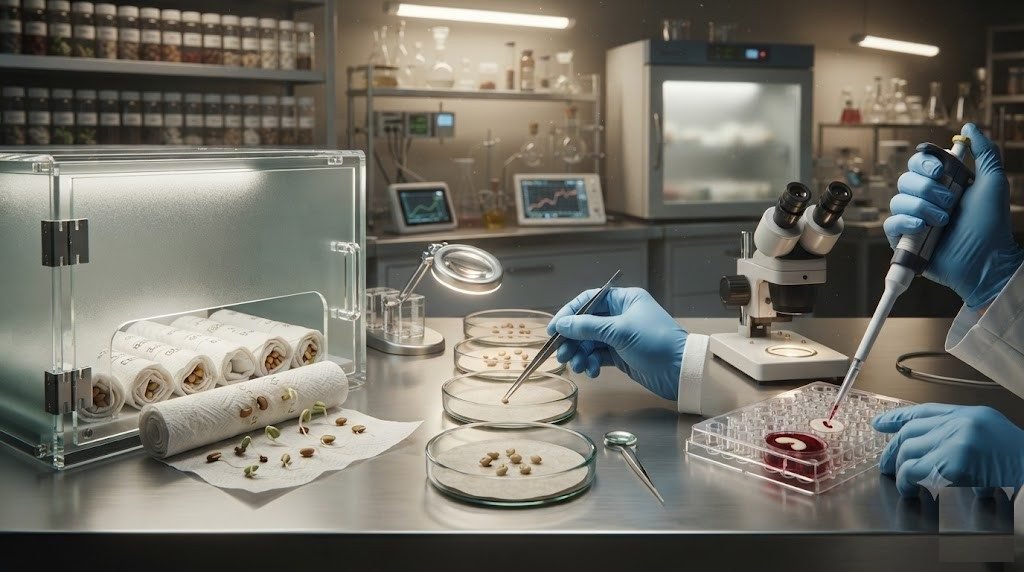
The Ragdoll test is the most accessible, reliable, and non-destructive viability assay for home seed savers, market growers, and community seed libraries:
| Procedural Step | Technical Specification | Operational Execution | Common Pitfall to Avoid |
|---|---|---|---|
| 1. Sample Selection | Count exactly 10, 20, or 50 seeds randomly from the seed lot. | Avoid selectively picking only the largest seeds; sample must be representative. | Do NOT hand-select pretty seeds; bias invalidates statistical percentage. |
| 2. Substrate Prep | High-wet-strength unbleached paper towel dampened with distilled water. | Moisten towel so it is damp throughout without dripping (‘wrung-out sponge’). | Excessive water drowns seed embryos, inducing anaerobic rot. |
| 3. Seed Placement | Space seeds evenly along top third of paper towel sheet. | Leave 2 to 3 cm spacing between seeds to prevent mold transfer. | Crowding seeds allows fungal damping-off to spread across sample. |
| 4. Rolling & Bagging | Roll towel loosely into a cylinder (‘ragdoll’); place inside plastic ziplock bag. | Leave bag slightly vented for oxygen exchange; store upright in dark warm room (21°C – 25°C). | Airtight sealing suffocates respiring embryos. |
| 5. Evaluation & Count | Inspect at standard ISTA evaluation milestones (e.g., Day 4, 7, and 14). | Count only normal seedlings with healthy, elongated white radicles and intact cotyledons. | Do NOT count abnormal seedlings (curled radicles, stunted rootless shoots). |
Biochemical Tetrazolium (TZ) Assays for Rapid Embryo Staining
When seed bank managers require immediate viability results for dormant tree or flower seeds that would otherwise take months of cold stratification to germinate, they deploy the Tetrazolium (TZ) Test. Seeds are bisected longitudinally through the embryo and submerged in a 0.5% to 1.0% aqueous solution of 2,3,5-triphenyl tetrazolium chloride.
In living embryo cells, active respiratory dehydrogenase enzymes release hydrogen ions that chemically reduce the clear, colorless tetrazolium salt into an insoluble, vivid carmine-red dye termed formazan. Under a stereomicroscope, living, respiring embryonic tissues (radicle tip, embryonic shoot, cotyledons) stain bright red within two hours, while dead or non-viable tissues remain ghostly white, providing definitive viability confirmation in less than half a day.
ISTA Rules, Statistical Sampling, and Randomization Protocols
In international seed certification and laboratory testing, seed testing is governed strictly by the International Rules for Seed Testing published by ISTA (International Seed Testing Association) and AOSA (Association of Official Seed Analysts). A primary rule of seed analysis is that a test result is only as accurate as the representative nature of the sample taken from the bulk seed container.
To obtain an unbiased working sample from a 5-kilogram seed lot, technicians deploy standardized soil dividers or Boerner conical dividers that mechanically split bulk seed lots into equal, randomized fractions. For statutory germination certification, testing mandates four replicates of 100 seeds each (400 seeds total) tested in parallel. For small-scale home seed libraries and community seed swaps, a simplified sample of 20 to 50 seeds provides a reliable statistical baseline with a margin of error under ±5%.
🌱 The Biochemical Mechanism of the Tetrazolium (TZ) Reaction
The Tetrazolium test (2,3,5-triphenyl tetrazolium chloride) is an elegant biochemical assay of cellular respiration. In living plant cells, the dehydrogenase enzymes of the citric acid cycle (Krebs cycle) transfer hydrogen ions to the colorless tetrazolium salt. The addition of hydrogen reduces the soluble salt into triphenylformazan—an insoluble, intensely red compound that stains living cell structures carmine-red. Dead tissues lacking active mitochondrial enzymes remain completely unstained, providing definitive viability confirmation in just 2 to 4 hours.
Normal vs. Abnormal Seedling Classification Criteria
When evaluating a Ragdoll paper towel test at the final count milestone, counting mere radicle emergence is insufficient. ISTA guidelines divide germinated seeds into strict diagnostic categories:
| Diagnostic Category | Morphological Anatomical Presentation | Agronomic Classification | Included in Viability % |
|---|---|---|---|
| Normal Vigorous Seedling | Well-developed elongated primary root with root hairs; intact hypocotyl; green healthy cotyledons. | Certified Viable & Vigorous. | YES (Counted toward official germination rate). |
| Abnormal Stunted Seedling | Curled, stunted, or missing radicle; fractured hypocotyl; glassy water-soaked cotyledons. | Non-Viable (Incapable of field survival). | NO (Excluded from official germination percentage). |
| Hard Dormant Seed | Seed remains hard, firm, and unswollen; zero mold; seed coat impermeable to water. | Viable but Dormant. | Counted as ‘Hard Seed’; reported separately on seed labels. |
| Dead / Rotted Seed | Soft, mushy, collapsed seed; heavy fungal mold hyphae; foul bacterial odor. | Dead / Decayed. | NO (Recorded as dead seed percentage). |
Electrical Conductivity (EC) Seedling Vigor Testing
To assess seed vigor beyond simple germination percentage, seed laboratories deploy the Electrical Conductivity (EC) Test. When seeds with damaged, aged cell membranes are soaked in deionized water for 24 hours, they leak electrolytes (potassium, sodium, and chloride ions) into the water. A digital conductivity meter measures the electrical conductivity of the soak water: high electrolyte leakage (> 30 μS/cm/g) indicates degraded cell membranes and low field vigor, while low conductivity (< 15 μS/cm/g) proves high vigor and exceptional storage potential.
International Seed Testing Rules (ISTA / AOSA) and Genebank Protocols
The scientific discipline of seed preservation and quality assessment is codified globally by two preeminent organizations: the International Seed Testing Association (ISTA) and the Association of Official Seed Analysts (AOSA). These bodies establish precise, legally binding laboratory testing protocols governing working sample sizes, seed purity determination, moisture meters calibration, and standard germination testing conditions (including specific substrate media, diurnal temperature cycles, and first/final seedling evaluation counts). In long-term ex situ genetic conservation, public genebanks—such as the USDA National Center for Genetic Resources Preservation (NCGRP) and the Millennium Seed Bank at Kew—adhere to the FAO Genebank Standards for Plant Genetic Resources for Food and Agriculture.
The FAO Genebank Standards define exact operational criteria for preserving orthodox crop germplasm:
- Accession Regeneration Triggers: A seed accession stored in a base collection must undergo field regeneration whenever viability drops below 85% of its initial storage baseline, or when total seed inventory falls below 1,500 viable seeds.
- Moisture Equilibrium Standards: Seeds must be desiccated in humidity-controlled drying rooms (15°C and 15% relative humidity) until internal seed moisture content reaches equilibrium between 3% and 7% depending on seed lipid composition.
- Storage Thermal Regime: Base collections destined for multi-decade conservation must be stored in hermetically sealed moisture-proof containers at -18°C ± 2°C (0°F) with an internal relative humidity of 15% ± 3%.
Orthodox, Intermediate, and Recalcitrant Seed Longevity Classifications
In seed preservation biology, plant species are categorized into three distinct physiological storage classifications that dictate their preservation feasibility:
| Storage Physiology Class | Desiccation Tolerance Limit | Freezer Survivability (-18°C) | Representative Plant Families & Crops |
|---|---|---|---|
| Orthodox Seeds | Tolerates extreme dehydration down to 3% – 7% moisture. | Survives sub-zero freezing for decades with zero tissue rupture. | 90%+ of agricultural crops: Solanaceae (Tomatoes), Brassicaceae, Cucurbits, Fabaceae. |
| Intermediate Seeds | Tolerates drying to 10% – 15% moisture; damaged by severe drying. | Sensitive to sub-zero freezing; loses viability rapidly below -5°C. | Citrus species, Coffee (Coffea arabica), Papaya, Neem, certain tropical palms. |
| Recalcitrant Seeds | Intolerant of desiccation; cell death occurs below 30% – 40% moisture. | Killed instantly by freezing temperatures (intracellular ice crystals). | Tropical rainforest trees, Avocados, Mangoes, Cacao, Oaks (Acorns), Chestnuts. |
Technical Frequently Asked Questions (FAQ)
What is Harrington’s Rule of seed storage, and how does it predict seed lifespan?
Formulated by seed physiologist Dr. James F. Harrington, Harrington’s Rules are empirical principles that quantify the mathematical relationship between environmental conditions and orthodox seed longevity: Rule 1: For every 1% reduction in seed moisture content (between 5% and 14%), the potential storage lifespan of the seed doubles! Rule 2: For every 5°C (10°F) reduction in storage temperature (between 0°C and 50°C), the potential storage lifespan of the seed doubles! Combining low moisture (5% to 7%) with freezer temperatures (-18°C) produces a multiplicative exponential lifespan extension, allowing orthodox seeds to survive for decades.
How does the biochemical Tetrazolium (TZ) test determine seed viability in hours?
The Tetrazolium test (2,3,5-triphenyl tetrazolium chloride) is an enzymatic assay of cellular respiration. When a dormant or non-germinated seed is cut in half and soaked in a clear 1% tetrazolium solution, active respiratory dehydrogenase enzymes inside living cells release hydrogen ions. These ions chemically reduce the colorless salt into an insoluble, vivid red dye called formazan, staining living embryonic tissues bright carmine red. Dead or decayed tissues lack active respiratory enzymes and remain uncolored or ghostly white, providing definitive viability confirmation in just 2 to 4 hours without waiting weeks for seedlings to sprout.
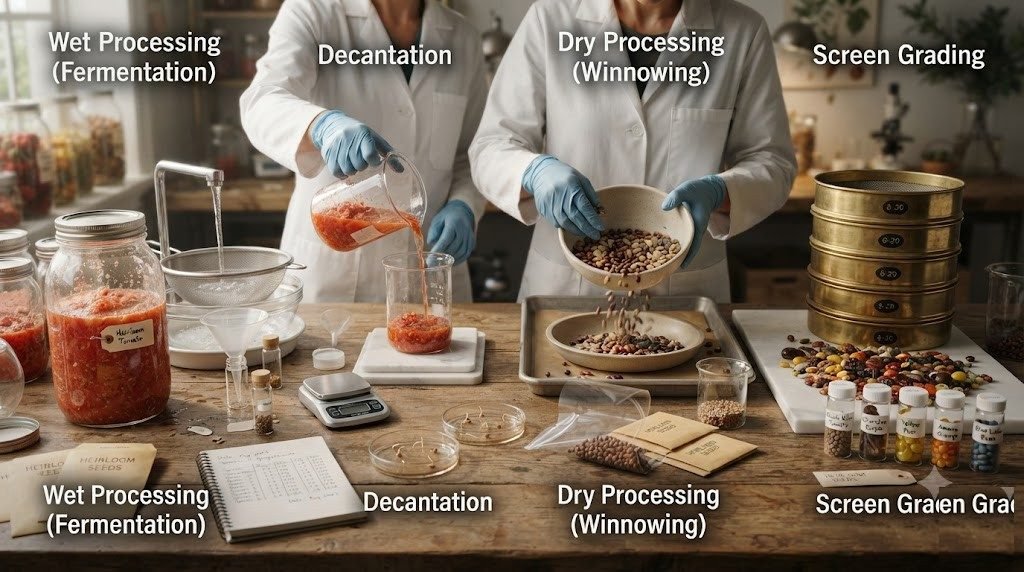
Why is winnowing effective at separating viable seeds from hollow hulls and chaff?
Winnowing relies on the aerodynamic principle of terminal settling velocity. When a mixture of harvested seeds and crushed plant chaff is dropped through a horizontal air current (from an electric fan or natural breeze), aerodynamic drag acts upon the surface area of each particle while gravity pulls its mass downward. Dried chaff, pod fragments, and hollow unpollinated seeds have high surface area relative to their lightweight mass, giving them a very low terminal velocity that allows moving air to carry them away horizontally. Dense, embryo-filled viable seeds have high mass relative to surface area and fall straight down into the collection container.
What is the difference between seed germination capacity and seedling vigor?
Germination capacity is the total percentage of seeds that push a radical under ideal, controlled laboratory conditions (optimal temperature, sterile moist blotter, perfect humidity). Seedling vigor is the physiological capability of those emerging seedlings to perform under real-world garden stress: pushing through crusted soil, tolerating cold spring rain, resisting soil-borne damping-off fungi, and establishing vigorous root systems. Old or poorly stored seeds may still demonstrate 75% germination capacity on a warm moist paper towel in a laboratory, but exhibit near-zero field vigor, emerging as stunted, weak seedlings that quickly die in garden beds.
Statistical Confidence Intervals and Margin of Error in Small Sample Testing
When home seed savers and community seed library volunteers conduct germination viability assays using modest sample sizes (such as 20 or 50 seeds in a Ragdoll paper towel test), understanding the underlying binomial statistical distribution is essential. In a 20-seed test, each individual seed represents 5% of the total result: if 18 out of 20 seeds germinate, the calculated germination rate is 90%.
However, under mathematical binomial probability, a 20-seed sample carries an approximate 95% confidence interval margin of error of ±12%. If that same seed lot is tested using a certified 400-seed sample (four replicates of 100 seeds), the margin of error narrows to ±3%. For practical home gardening and community seed exchanges, a 20-seed test is entirely sufficient to distinguish vigorous seed lots (> 80%) from degraded batches (< 50%) that require double-density planting or replacement.
Microbial Disinfection Pre-Treatments for Paper Towel Assays
During a 14-day Ragdoll paper towel test, the warm, moist, humid environment inside the plastic ziplock bag creates ideal conditions for opportunistic saprophytic molds (such as Rhizopus and Penicillium). If untreated seeds carry surface fungal spores, white mold hyphae can spread across the towel, smothering healthy seeds and causing false-negative test results. Technicians pre-soak test seeds for 10 minutes in a mild 1% sodium hypochlorite (household bleach diluted 1:5) or 3% hydrogen peroxide solution, followed by rinsing with sterile distilled water before placing on the moist towel, ensuring pristine mold-free evaluation.