In seed banking, commercial seed production, and community seed saving, harvesting botanical seeds from the mother plant is only the first phase of seed stewardship. Raw seed collections arriving from the garden or field are contaminated with plant chaff, dried husks, dirt particles, weed seeds, insect frass, and hollow unfertilized seed coats. Furthermore, seeds born inside wet, pulpy fruits carry gelatinous germination inhibitors and fungal spores that guarantee rot if not properly processed.
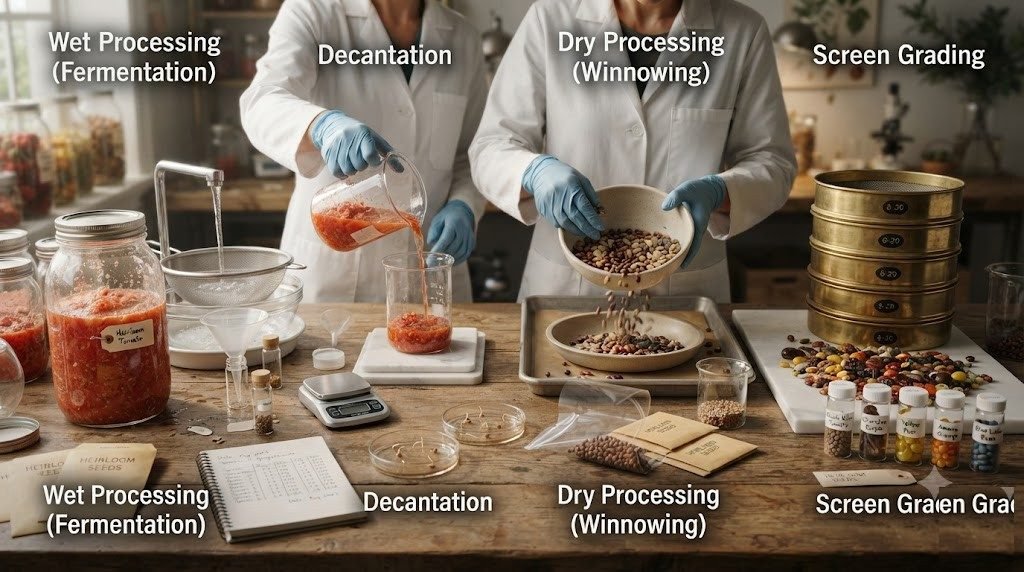
To produce clean, viable, high-vigor seed lots, seed stewards master the two fundamental operational paradigms of seed post-harvest handling: dry seed processing (threshing, screening, and winnowing) for crops whose seeds mature dry inside pods or seed heads; and wet seed processing (maceration, fermentation, and decantation) for seeds encased inside fleshy fruits.
🌱 The Aerodynamic Principle of Winnowing
Winnowing separates seed from chaff by harnessing differences in terminal settling velocity: dropping a mixture of seeds and crushed chaff through a controlled cross-current of air (from a natural breeze or an electric fan). Because dried chaff, husk flakes, and hollow unpollinated seeds have high surface-area-to-weight ratios, the moving air carries them away horizontally, while dense, embryo-filled viable seeds fall straight downward into the collection bin.
| Processing Category | Target Crop Families | Core Mechanical Operations | Primary Equipment Utilized |
|---|---|---|---|
| Dry Seed Processing | Fabaceae (Beans/Peas), Brassicaceae (Mustards), Alliums, Asteraceae (Sunflowers). | Crushing, flailing, rubbing, screening through graduated sieves, and air-column winnowing. | Canvas tarps, rubber threshing paddles, nested brass seed sieves, variable-speed electric fans. |
| Wet Seed Processing | Solanaceae (Tomatoes/Peppers), Cucurbitaceae (Melons/Squash), Rosaceae (Berries). | Maceration, 48-hr microbial fermentation, water decantation, and rapid low-temperature air drying. | Non-metallic fermentation tubs, high-pressure water sprayers, 20-mesh sieves, dehydrator screens. |
The Precision Decantation Method for Wet Seed Cleaning
For wet-seeded crops—such as squashes, watermelons, and fermented tomatoes—the premier technique for separating viable seed from fruit pulp without chemical solvents is density decantation. The macerated pulp-seed slurry is poured into a tall, clear bucket with a five-fold volume of cold water and stirred vigorously:
- Floaters (Unviable Debris): Light fruit pulp, fibrous placenta strings, and unfertilized, hollow, or insect-damaged seeds possess low specific gravity and float buoyant at the water’s surface.
- Sinkers (Viable Seeds): Plump, fully developed seeds containing dense, lipid- and protein-rich embryos possess high specific gravity and sink rapidly to the bottom.
The operator slowly pours off the top water layer containing the floaters, refills the bucket with fresh water, and repeats the decantation three to four times until only sparkling clean seeds remain at the base.
Aerodynamic Terminal Velocity and Winnowing Physics
The mechanical separation of dry botanical seeds from plant chaff, husks, and floral bracts is governed by the principles of fluid dynamics and terminal settling velocity (vt). When a particle falls through a moving air column, gravitational force pulls it downward while aerodynamic drag force pushes it upward. Terminal velocity occurs when drag equals gravity:
vt = √[ (2 · m · g) / (ρ · A · Cd) ]
where m is particle mass, g is gravitational acceleration, ρ is air density, A is projected frontal surface area, and Cd is the drag coefficient. Because dried chaff flakes and hollow unpollinated seeds have high surface area relative to their featherweight mass (low mass-to-surface-area ratio), their terminal velocity is very low (typically 1.5 to 2.5 m/s). Conversely, dense, embryo-filled seeds have a high terminal velocity (5.0 to 8.0 m/s). By tuning an electric winnowing fan’s air velocity to 3.5 m/s, 100% of chaff is blown away while viable seeds fall cleanly into the collection box.
🌱 Graduated Brass Sieve Sizing and Screen Slot Physics
Professional seed houses utilize nested stacks of precision round-hole and slotted-hole brass screens. Round-hole screens (measured in 64ths of an inch) sort seeds based on width and diameter, while slotted-hole screens sort seeds based on thickness. A two-screen system is universally deployed: an upper ‘scalper’ screen that catches coarse pods and stems while letting seeds fall through, and a lower ‘sifter’ screen that holds viable seeds while allowing dust, weed seeds, and broken debris to fall away.
Microbial Fermentation Dynamics and Pectinase Breakdown in Wet Seeds
For wet-seeded crops (such as tomatoes, squashes, and peppers), fermentation accomplishes what mechanical screening cannot: the biochemical dissolution of mucilage. In a closed fermentation tub, natural anaerobic and facultative anaerobic bacteria proliferate, consuming free sugars and producing lactic and acetic acids that drop the slurry pH to 3.8. Fungal mycelia produce endo-pectin lyase that breaks down the locular gel in 48 to 72 hours. Dense viable seeds sink to the bottom of the container, allowing light pulp and unfertilized hollow seeds to be decanted and flushed away with cold water.
International Seed Testing Rules (ISTA / AOSA) and Genebank Protocols
The scientific discipline of seed preservation and quality assessment is codified globally by two preeminent organizations: the International Seed Testing Association (ISTA) and the Association of Official Seed Analysts (AOSA). These bodies establish precise, legally binding laboratory testing protocols governing working sample sizes, seed purity determination, moisture meters calibration, and standard germination testing conditions (including specific substrate media, diurnal temperature cycles, and first/final seedling evaluation counts). In long-term ex situ genetic conservation, public genebanks—such as the USDA National Center for Genetic Resources Preservation (NCGRP) and the Millennium Seed Bank at Kew—adhere to the FAO Genebank Standards for Plant Genetic Resources for Food and Agriculture.
The FAO Genebank Standards define exact operational criteria for preserving orthodox crop germplasm:
- Accession Regeneration Triggers: A seed accession stored in a base collection must undergo field regeneration whenever viability drops below 85% of its initial storage baseline, or when total seed inventory falls below 1,500 viable seeds.
- Moisture Equilibrium Standards: Seeds must be desiccated in humidity-controlled drying rooms (15°C and 15% relative humidity) until internal seed moisture content reaches equilibrium between 3% and 7% depending on seed lipid composition.
- Storage Thermal Regime: Base collections destined for multi-decade conservation must be stored in hermetically sealed moisture-proof containers at -18°C ± 2°C (0°F) with an internal relative humidity of 15% ± 3%.
Orthodox, Intermediate, and Recalcitrant Seed Longevity Classifications
In seed preservation biology, plant species are categorized into three distinct physiological storage classifications that dictate their preservation feasibility:
| Storage Physiology Class | Desiccation Tolerance Limit | Freezer Survivability (-18°C) | Representative Plant Families & Crops |
|---|---|---|---|
| Orthodox Seeds | Tolerates extreme dehydration down to 3% – 7% moisture. | Survives sub-zero freezing for decades with zero tissue rupture. | 90%+ of agricultural crops: Solanaceae (Tomatoes), Brassicaceae, Cucurbits, Fabaceae. |
| Intermediate Seeds | Tolerates drying to 10% – 15% moisture; damaged by severe drying. | Sensitive to sub-zero freezing; loses viability rapidly below -5°C. | Citrus species, Coffee (Coffea arabica), Papaya, Neem, certain tropical palms. |
| Recalcitrant Seeds | Intolerant of desiccation; cell death occurs below 30% – 40% moisture. | Killed instantly by freezing temperatures (intracellular ice crystals). | Tropical rainforest trees, Avocados, Mangoes, Cacao, Oaks (Acorns), Chestnuts. |
Technical Frequently Asked Questions (FAQ)
What is Harrington’s Rule of seed storage, and how does it predict seed lifespan?
Formulated by seed physiologist Dr. James F. Harrington, Harrington’s Rules are empirical principles that quantify the mathematical relationship between environmental conditions and orthodox seed longevity: Rule 1: For every 1% reduction in seed moisture content (between 5% and 14%), the potential storage lifespan of the seed doubles! Rule 2: For every 5°C (10°F) reduction in storage temperature (between 0°C and 50°C), the potential storage lifespan of the seed doubles! Combining low moisture (5% to 7%) with freezer temperatures (-18°C) produces a multiplicative exponential lifespan extension, allowing orthodox seeds to survive for decades.
How does the biochemical Tetrazolium (TZ) test determine seed viability in hours?
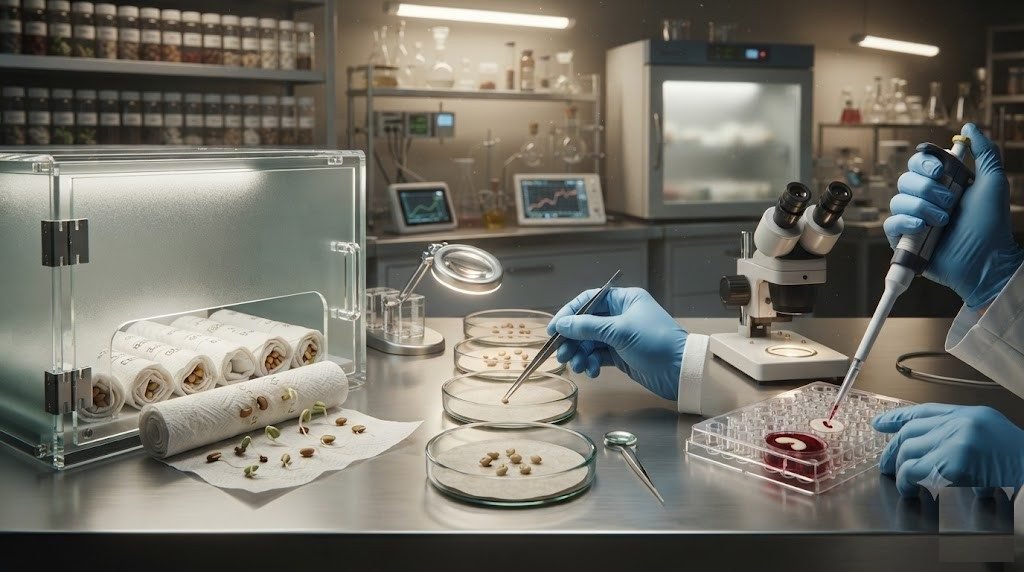
The Tetrazolium test (2,3,5-triphenyl tetrazolium chloride) is an enzymatic assay of cellular respiration. When a dormant or non-germinated seed is cut in half and soaked in a clear 1% tetrazolium solution, active respiratory dehydrogenase enzymes inside living cells release hydrogen ions. These ions chemically reduce the colorless salt into an insoluble, vivid red dye called formazan, staining living embryonic tissues bright carmine red. Dead or decayed tissues lack active respiratory enzymes and remain uncolored or ghostly white, providing definitive viability confirmation in just 2 to 4 hours without waiting weeks for seedlings to sprout.
Why is winnowing effective at separating viable seeds from hollow hulls and chaff?
Winnowing relies on the aerodynamic principle of terminal settling velocity. When a mixture of harvested seeds and crushed plant chaff is dropped through a horizontal air current (from an electric fan or natural breeze), aerodynamic drag acts upon the surface area of each particle while gravity pulls its mass downward. Dried chaff, pod fragments, and hollow unpollinated seeds have high surface area relative to their lightweight mass, giving them a very low terminal velocity that allows moving air to carry them away horizontally. Dense, embryo-filled viable seeds have high mass relative to surface area and fall straight down into the collection container.
What is the difference between seed germination capacity and seedling vigor?
Germination capacity is the total percentage of seeds that push a radical under ideal, controlled laboratory conditions (optimal temperature, sterile moist blotter, perfect humidity). Seedling vigor is the physiological capability of those emerging seedlings to perform under real-world garden stress: pushing through crusted soil, tolerating cold spring rain, resisting soil-borne damping-off fungi, and establishing vigorous root systems. Old or poorly stored seeds may still demonstrate 75% germination capacity on a warm moist paper towel in a laboratory, but exhibit near-zero field vigor, emerging as stunted, weak seedlings that quickly die in garden beds.
The Fluid Dynamics of Water Density Decantation and Specific Gravity
The separation of high-vigor botanical seeds from lightweight fruit pulp and hollow shells during wet seed processing is governed by Archimedes’ principle and specific gravity. A fully developed, viable seed containing a dense embryo packed with storage lipids and crystalloid protein bodies exhibits a specific gravity typically between 1.15 and 1.30 g/cm3, noticeably denser than pure water (1.00 g/cm3). Consequently, viable seeds sink rapidly to the bottom of the wash tank.
Conversely, fruit placental fibers, pericarp debris, and unpollinated or abortive seeds (which contain empty air pockets where the embryo failed to develop) possess a specific gravity less than 1.00 g/cm3, causing them to float buoyantly on the water’s surface. By tilting the container at a 45-degree angle under a gentle stream of cold water, the buoyant fraction spills over the rim while the dense viable seeds remain settled on the bottom, achieving 99%+ purity without mechanical damage.
Rotary Air-Column Seed Aspiration Mechanics for Dry Seed Stocks
In professional dry seed cleaning, commercial seed houses deploy vertical air-column seed aspirators (such as the South Dakota Seed Blower). Unlike simple outdoor box fans that blow air horizontally, an air-column aspirator introduces seeds into a vertical acrylic column with a precisely regulated upward airflow generated by a calibrated centrifugal blower motor.
As seeds drop through the vertical column, the upward air current suspends the mixture in fluid dynamic equilibrium: lightweight chaff, empty seed coats, and broken fragments are lifted upward into cyclone collection chambers, while plump, heavy seeds overcome the upward air velocity and drop downward into the clean seed drawer. By adjusting the airflow valve with millimeter precision, operators can grade seed lots not only for purity, but for high seedling vigor by retaining only the heaviest 80% of the seed harvest.
Sanitization and Drying Trays: Avoiding Mesh Screen Entanglement
Freshly decanted wet seeds must be transferred immediately to drying surfaces. A common mistake is drying wet seeds on paper towels or cardboard, where sticky wet seed mucilage cements the seeds to the paper fibers, making them impossible to detach without ripping seed coats. Propagators spread wet seeds in a thin layer across non-stick fiberglass window screening or unbleached silicone baking parchment, stirring twice daily beneath circulating fans to ensure rapid, uniform dehydration within 48 hours.
Properly dried and winnowed seed lots achieve superior aesthetic purity and long storage viability, meeting the highest standards for community seed library exchanges and commercial seed sales. Rigorous screening and winnowing protect seed banking accessions from insect infestations, mold decay, and physical deterioration, guaranteeing decades of viable germination.