In organic horticulture and heritage crop conservation, saving seeds from heirloom tomatoes (Solanum lycopersicum) represents the gold standard of varietal preservation. Unlike commercial F1 hybrid tomatoes whose progeny segregate unpredictably into erratic wild traits, open-pollinated heirloom cultivars—such as ‘Brandywine’, ‘Cherokee Purple’, and ‘San Marzano’—breed completely true-to-type across generations, preserving unique flavor profiles, regional disease tolerances, and complex polygenic traits refined over centuries.
However, tomato seed extraction is fundamentally distinct from dry-seeded crops. Every viable tomato seed within a ripe fruit is encased inside a gelatinous placental envelope known as the locular gel sac. This mucilaginous sheath contains concentrated biochemical germination inhibitors—primarily abscisic acid (ABA), phenolic compounds, and osmotic solutes—designed by evolutionary biology to prevent premature vivipary (seeds sprouting inside the warm, moist maternal fruit). Successfully saving tomato seeds requires overcoming this chemical dormancy through controlled wet microbial fermentation.
🌱 The Physiological Purpose of Wet Fermentation
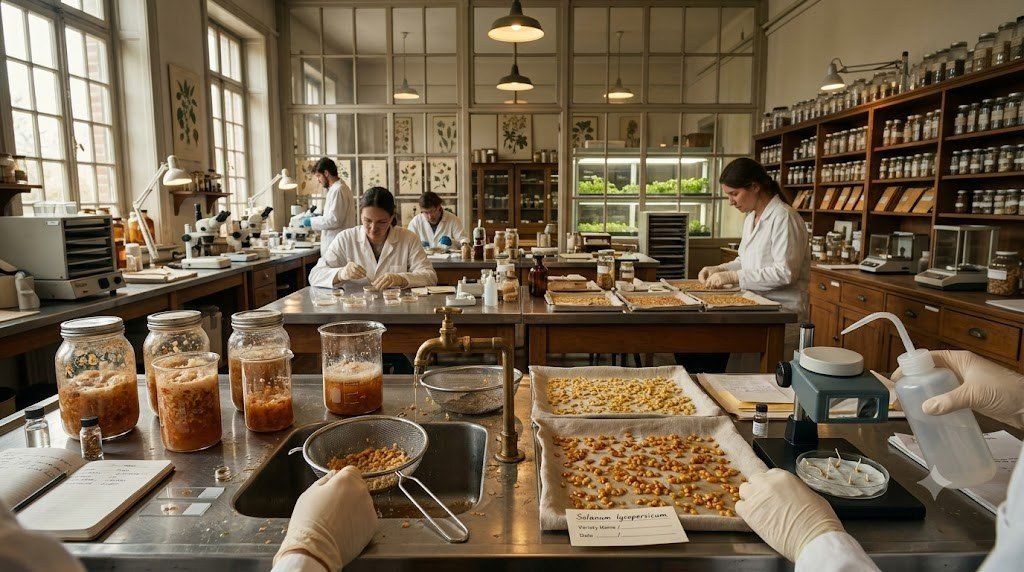
Fermenting crushed tomato pulp for 48 to 72 hours mimics the natural fungal decay of fallen fruit on the forest floor. Beneficial colonies of Penicillium and Aspergillus fungi release hydrolytic pectinase enzymes that dissolve the mucilaginous sheath, while producing natural bio-fungicidal antibiotics that eradicate seed-borne bacterial canker (Clavibacter michiganensis) and tobacco mosaic virus (TMV) from the seed coat without synthetic agrochemicals.
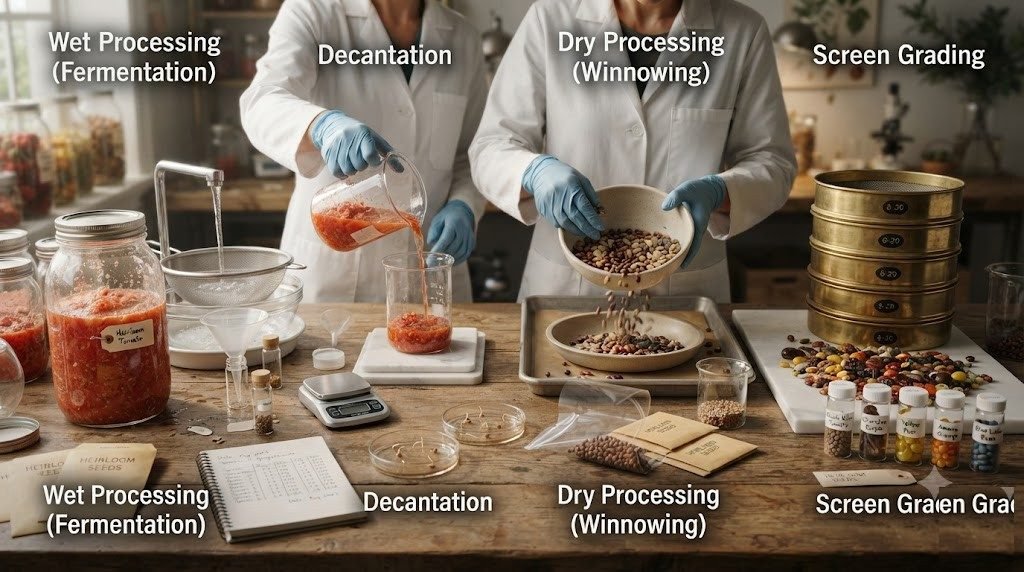
The Wet Fermentation Extraction Workflow
To produce clean, pathogen-free, and high-germination heirloom tomato seeds, seed stewards execute a precise laboratory-grade wet processing protocol:
| Process Phase | Target Duration & Environment | Biochemical & Physical Action | Critical Quality Control Indicator |
|---|---|---|---|
| Fruit Selection | Peak ripeness to slightly soft; vine-ripened. | Harvest from disease-free, true-to-type mother plants. | Avoid green shoulders or blossom-end rot affected fruits. |
| Maceration & Slurry Prep | Ambient 20°C to 24°C (68°F – 75°F). | Squeeze pulp, locular gel, and seeds into non-metallic container with equal volume water. | Loosely cover with breathable cheesecloth to permit oxygen transfer while excluding fruit flies. |
| Fungal Fermentation | 48 to 72 hours max (stir daily). | Surface white mold mycelium develops; pectinase enzymes digest gel. | Fermentation is complete the moment viable seeds sink to bottom and mold layer forms. |
| Decantation & Washing | Cold running water through mesh sieve. | Pour off floating pulp, mold scum, and light unviable hollow seeds. | Viable, dense, embryo-filled seeds settle firmly at container bottom. |
| Controlled Drying | 5 to 7 days on unbleached parchment. | Dehydrate seeds at < 35°C (95°F) in circulating air. | Seeds must achieve < 8% equilibrium moisture content (crisp snap test). |
Genetic Isolation Distances and Stigma Morphology
While tomato flowers are predominantly self-pollinating (autogamous), modern and heirloom cultivars exhibit differing degrees of cross-pollination risk depending on their floral morphology. Modern determinate cultivars feature recessed stigmas held safely within the anther cone, requiring minimal isolation (3 to 5 meters). Conversely, many historic potato-leaf heirlooms (such as ‘Brandywine’) and wild currant varieties (Solanum pimpinellifolium) possess exserted stigmas that protrude beyond the protective stamen ring.
When bumblebees (Bombus spp.) perform buzz-pollination by vibrating their thoracic muscles at 400 Hz, pollen is shaken loose and easily transferred between adjacent exserted flowers. To guarantee absolute varietal purity, heirloom tomatoes with exserted stigmas require an isolation distance of at least 15 to 30 meters, or physical isolation using spun-bond polyester blossom bags tied over flower clusters prior to anthesis.
Biochemical Pectinase Enzymatic Kinetics in Wet Fermentation
The locular gel envelope surrounding a tomato seed is primarily composed of complex cross-linked pectin chains, arabinogalactans, and polygalacturonic acids. In living fruit, this mucilaginous barrier maintains high osmotic potential and contains concentrated phenolic acids (including ferulic and caffeic acids) that actively suppress embryo respiration. During wet fermentation, ambient fungal spores of Geotrichum candidum, Penicillium, and lactic acid bacteria (Lactobacillus spp.) colonize the aerobic surface of the fermenting slurry.
These microorganisms secrete extracellular endo-polygalacturonase and pectin methylesterase enzymes. These biocatalytic enzymes hydrolyze the α-(1→4)-glycosidic bonds linking the D-galacturonic acid residues of the pectin matrix, degrading the gel into soluble monomers in 48 to 72 hours. Simultaneously, lactic and acetic acid production drives the slurry pH down to 3.8 – 4.2. This natural bio-acidification creates an inhospitable environment for pathogenic gram-negative bacteria, effectively sanitizing the seed coat without requiring caustic chemical fungicides.
🌱 The Thermal Threshold of Premature Sprouting During Fermentation
A critical operational hazard during wet tomato seed fermentation is ambient temperature control. If the fermentation container is kept in an environment exceeding 27°C (80°F), the combination of dissolved gel inhibitors, moisture, and elevated thermal energy can trigger premature germination inside the fermenting bucket! Once a tomato seed pushes even 0.5 mm of its white radicle tip through the micropyle, drying the seed will kill the emerged embryo, rendering the entire seed lot 100% sterile. Fermentation must strictly be maintained at 20°C to 24°C (68°F – 75°F).
Seed Coat Trichomes, Lignification, and Water Dehydration Kinetics
Under a scanning electron microscope (SEM), a dried heirloom tomato seed reveals a dense coating of microscopic, hair-like structures known as seed coat trichomes. These unicellular epidermal hairs are flattened against the testa when dry, but expand rapidly upon water contact during sowing, acting as micro-capillaries that channel moisture directly to the micropylar opening.
Dehydrating washed tomato seeds demands careful moisture management. Freshly washed seeds emerge from the decantation sieve with internal moisture contents exceeding 50%. Drying must proceed in two distinct thermodynamic phases:
- Phase I (Surface Water Desorption): High-volume circulating air at 22°C to 28°C strips surface liquid within 6 to 12 hours, collapsing trichomes and preventing surface mold germination.
- Phase II (Equilibrium Internal Dehydration): The seeds slowly release bound cellular water over 5 to 7 days until reaching an internal moisture equilibrium of 6% to 8%, where metabolic respiration ceases completely.
Genetic Purity Protocols and Blossom Bagging Construction
To produce certified pure heirloom seed from cultivars with protruding exserted stigmas (such as ‘Brandywine’ or ‘German Pink’), seed savers construct lightweight blossom exclusion cages or bags. Organza fabric bags with a 50-mesh aperture (pore size < 0.3 mm) are slipped over immature green flower buds several days before petals open. The drawstring is cinched tightly around the stem pedicel and padded with a small strip of raw sheep’s wool or cotton batting to prevent crawling thrips or aphids from squeezing inside.
Regulatory Standards, ISTA Protocols, and Seed Certification
The commercial distribution and genetic conservation of vegetable seed stocks are governed by comprehensive international and national legal standards. In the United States, the Federal Seed Act (7 U.S.C. 1551) and individual state seed laws enforce minimum germination standards, noxious weed seed tolerances, and varietal trueness labeling. Internationally, the International Seed Testing Association (ISTA) and the Association of Official Seed Analysts (AOSA) publish standardized laboratory protocols for measuring seed purity, moisture content, and germination percentages.
For commercial certified seed production, seed lots must satisfy rigorous four-tier certification standards established by the Association of Official Seed Certifying Agencies (AOSCA):
- Breeder Seed: The highest genetic tier, directly controlled by the originating plant breeder or university agricultural experiment station, guaranteeing 100% varietal purity.
- Foundation Seed: Produced from breeder seed and maintained by agricultural universities or foundation seed organizations under maximum spatial isolation.
- Registered Seed: The progeny of foundation seed, carefully managed to maintain satisfactory genetic identity and purity for commercial multiplication.
- Certified Seed: The final commercial tier sold to farmers and home growers, certified to meet statutory minimum germination percentages (typically ≥ 75% for cucurbits and legumes; ≥ 80% for tomatoes and brassicas) and zero tolerance for designated noxious weed seeds.
Seed Health, Phytosanitary Testing, and Pathogen Exclusion
Seed-borne plant pathogens—including bacterial canker (Clavibacter in tomatoes), black rot (Xanthomonas campestris in brassicas), and anthracnose (Colletotrichum in beans)—can devastate entire agricultural regions if infected seed lots are shipped across borders. Certified seed laboratories deploy molecular diagnostic testing—including Polymerase Chain Reaction (PCR) assays, enzyme-linked immunosorbent assays (ELISA), and agar plating—to verify that seed lots are certified pathogen-free prior to issuing USDA-APHIS phytosanitary export certificates.
| Crop Family | Primary Seed-Borne Pathogen | Diagnostic Assay | Sanitation / Quarantine Benchmark |
|---|---|---|---|
| Solanaceae (Tomatoes) | Clavibacter michiganensis (Bacterial Canker) | Immunofluorescence / PCR | Zero tolerance; 48-hr fermentation or hot water treatment at 50°C for 25 min. |
| Brassicaceae (Cabbage/Kale) | Xanthomonas campestris (Black Rot) | Liquid plating on mCS20AB media | Zero tolerance; hot water treatment at 50°C (122°F) for 20 minutes. |
| Cucurbitaceae (Melons/Squash) | Acidovorax citrulli (Bacterial Fruit Blotch) | Seedling grow-out PCR assay (30,000 seeds) | Zero visual symptoms in 30,000 seedling greenhouse grow-out test. |
| Fabaceae (Beans/Peas) | Pseudomonas savastanoi (Halo Blight) | Agar dilution plating | Field roguing of infected plants; seed harvest strictly from disease-free fields. |
Technical Frequently Asked Questions (FAQ)
Why is hot water seed treatment recommended for brassica and tomato seeds?
Hot water treatment is a non-chemical thermotherapeutic protocol that eradicates internal and external seed-borne bacterial pathogens (such as bacterial canker, black rot, and bacterial spot) without harming seed viability. Seeds are submerged in precisely calibrated hot water (50°C / 122°F) for 20 to 25 minutes using a thermostatically controlled circulating water bath. The heat penetrates the seed coat, denaturing bacterial proteins while remaining just below the thermal death threshold of the plant embryo. Water temperatures must be monitored with ±0.5°C precision, as higher temperatures kill the embryo and lower temperatures fail to eliminate bacteria.
What is the difference between open-pollinated, heirloom, and F1 hybrid seeds?
Open-pollinated (OP) varieties are pollinated by natural mechanisms (wind, insects, or selfing) and breed true-to-type, producing offspring identical to the parent generation if isolated from crossing. An heirloom is an open-pollinated variety that possesses historic provenance, having been preserved, selected, and handed down through families, ethnic communities, or indigenous tribes for at least 50 years. An F1 hybrid is the first-generation offspring of an intentional cross between two highly inbred parent lines. F1 hybrids exhibit hybrid vigor (heterosis) in their first year, but their saved seeds segregate into genetically unpredictable, inferior wild forms in the second (F2) generation, making them unsuitable for seed saving.
How long do vegetable seeds remain viable in typical home storage?
Seed longevity depends on the botanical crop family and environmental storage conditions. Under standard cool, dark, dry room conditions (20°C and 40% relative humidity): Alliums (onions, leeks) and sweet corn have the shortest lifespan, remaining viable for only 1 to 2 years. Brassicas, carrots, and lettuce maintain good germination for 3 to 4 years. Solanaceous crops (tomatoes, peppers, eggplants), legumes (beans, peas), and cucurbits (squash, melons, cucumbers) are long-lived, routinely retaining high germination for 5 to 6+ years. Placing orthodox seeds in airtight glass jars with desiccants in a sub-zero freezer extends viability to 20 to 40+ years.
How can home seed savers prevent inbreeding depression in cross-pollinated crops?
Cross-pollinating (allogamous) crops—such as corn, cabbage, carrots, and onions—require a genetically diverse breeding population to maintain biological vigor. If a gardener saves seeds from only two or three individual cabbage plants year after year, recessive deleterious mutations accumulate, leading to severe inbreeding depression: stunted growth, reduced yields, loss of heading ability, and poor germination. To preserve genetic vigor, seed savers adhere to minimum population size rules: save seeds from at least 20 to 50 individual mother plants for brassicas and squashes, and at least 100 to 200 individual plants for wind-pollinated sweet corn.
Epigenetic Adaptation and Regional Landrace Breeding in Heirloom Tomatoes
When an heirloom tomato cultivar is grown and saved in the same geographic bioregion over multiple successive growing seasons, the plants undergo profound transgenerational epigenetic adaptation. While the underlying DNA sequence of the cultivar remains fundamentally conserved, environmental stressors—such as localized soil mineral imbalances, diurnal temperature swings, and indigenous mycorrhizal fungal communities—induce stable DNA methylation patterns and histone modifications across the genome.
These epigenetic marks are passed down through the embryonic cells of saved seeds. Progeny grown from regionally saved heirloom tomato seeds consistently demonstrate superior early-season cold tolerance, deeper root architecture, and enhanced systemic acquired resistance (SAR) against localized fungal blights (such as Alternaria solani) compared to identical seeds purchased from distant commercial nurseries. By saving seeds from the most vigorous, disease-free individual plants each autumn, home seed stewards actively participate in dynamic landrace development, breeding resilient heirloom strains exquisitely attuned to their micro-climate.
Furthermore, heirloom tomato seed banks provide an invaluable genetic reservoir against emerging viral threats, such as Tomato Brown Rugose Fruit Virus (ToBRFV). Diverse heirloom accessions frequently harbor uncharacterized wild resistance alleles that commercial breeders utilize to restore disease immunity to vulnerable commercial crops.