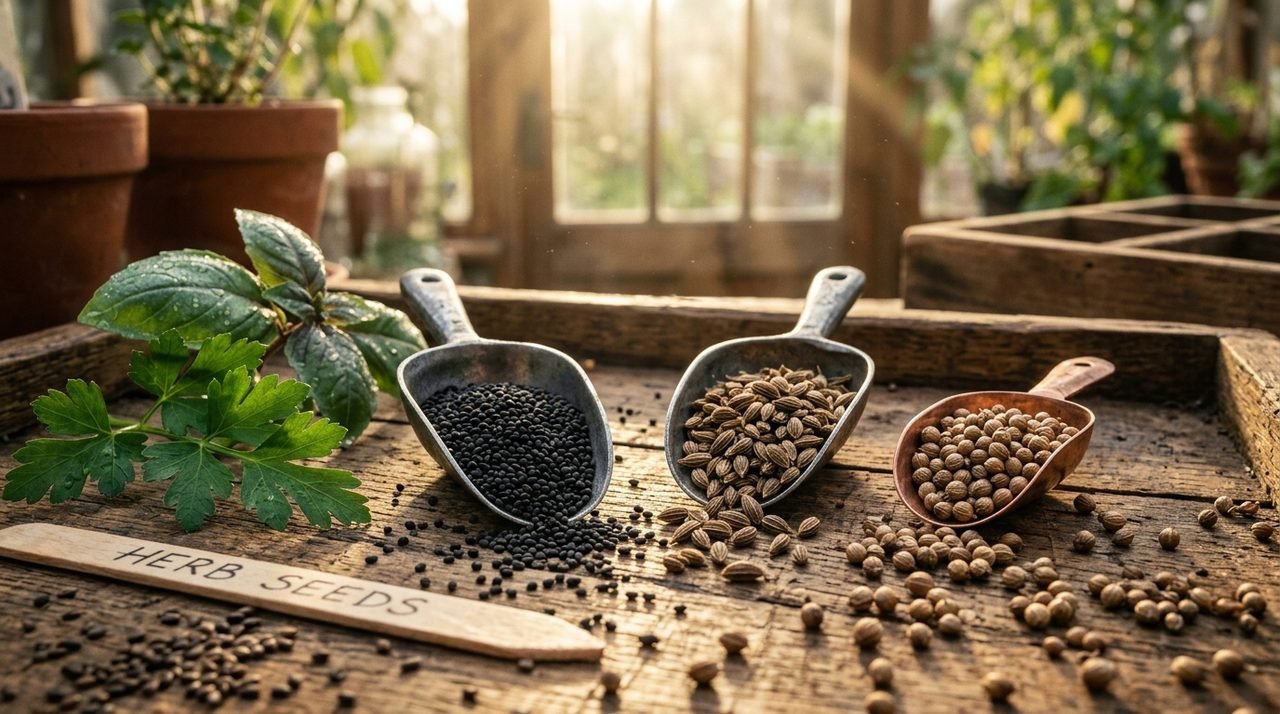
Culinary herbs—including sweet basil (Ocimum basilicum), flat-leaf and curly parsley (Petroselinum crispum), and cilantro or coriander (Coriandrum sativum)—are foundational to culinary traditions worldwide and represent the most frequently sown herbs in domestic kitchen gardens. Yet, horticulturists routinely encounter perplexing germination challenges: basil seeds suddenly coating themselves in a bizarre gelatinous slime upon watering, parsley seeds languishing for three to four weeks without emerging, and cilantro bolting prematurely to flower during early spring heatwaves.
Mastering culinary herb seed propagation requires an understanding of three distinct physiological adaptations: seed coat myxospermy (mucilage formation) in basil, underdeveloped embryo morphological dormancy in parsley, and schizocarp mericarp split mechanics in cilantro.
🌱 The Biophysics of Basil Seed Myxospermy
When dry, black basil seeds contact water, the outer epidermal cells of the seed coat rupture instantaneously, extruding hydrophilic pectin polysaccharides that swell into a clear, gelatinous halo around the seed. This biological mucilage serves three survival functions in arid Mediterranean soils: it acts as a water-holding sponge preventing embryo desiccation, glues the seed firmly to the soil particles against wind erosion, and facilitates gas exchange while inhibiting fungal spore hyphae.
Germination Parameters for Essential Culinary Herb Seeds
Because culinary herbs originate from divergent climate zones, their seeds require tailored environmental sowing triggers:
| Culinary Herb Crop | Botanical Family | Light Sensitivity (Photoblastism) | Optimal Soil Temperature | Typical Days to Emerge |
|---|---|---|---|---|
| Sweet Basil (Ocimum) | Lamiaceae (Mint) | Positively Photoblastic (requires light to germinate). | 24°C – 28°C (75°F – 82°F). | 5 to 8 days. |
| Parsley (Petroselinum) | Apiaceae (Carrot) | Light Neutral (tolerates shallow covering). | 18°C – 22°C (65°F – 72°F). | 18 to 28 days. |
| Cilantro / Coriander (Coriandrum) | Apiaceae (Carrot) | Negatively Photoblastic (prefers darkness / 1cm depth). | 15°C – 20°C (59°F – 68°F). | 10 to 14 days. |
| Dill (Anethum) | Apiaceae (Carrot) | Positively Photoblastic (needs surface light). | 18°C – 22°C (65°F – 72°F). | 7 to 12 days. |
Overcoming Parsley Seed Sluggishness and Furanocoumarins
The notoriously sluggish germination of parsley seeds is caused by a double inhibition: first, the seed embryo is physically immature at harvest and must undergo further cellular differentiation inside the moist seed coat; and second, the seed coat contains concentrated water-soluble furanocoumarins and volatile aromatic monoterpenes that act as biochemical germination inhibitors.
To slash parsley emergence time from nearly a month down to 7 to 9 days, experienced growers deploy a lukewarm hot-water priming soak. Seeds are submerged in hot water (45°C to 50°C / 115°F – 122°F) for 24 hours, changing the water three times to wash away the leached yellow furanocoumarins before sowing into moist, warm compost.
Myxospermy Hydrocolloid Chemistry and Moisture Capture in Basil
When a dry seed of sweet basil (Ocimum basilicum) is exposed to liquid water, it undergoes a dramatic physical transformation within 60 seconds: the outer layer of the seed coat swells into a thick, translucent, gelatinous mucilage capsule. This biological phenomenon, known as myxospermy, is caused by the rapid hydration of high-molecular-weight hydrophilic polysaccharides—specifically unbranched β-(1→4)-D-glucan chains linked with complex acidic arabinogalactans—stored in the primary cell walls of the seed epidermis.
Upon hydration, the cellulose microfibrils uncoil, generating an expansive hydrogel with extraordinary water-retention capacity. The mucilaginous sheath can absorb and hold more than 40 times its dry weight in water. In hot, arid, sunny Mediterranean growing environments, this hydrogel envelope creates an isolated micro-aquifer directly around the seed embryo, insulating it against rapid drying during midday sun and providing a stable hydration matrix that allows the radicle to emerge safely.
🌱 The Furanocoumarin Leaching Dynamics in Parsley Seeds
Parsley seeds (Petroselinum crispum) are packed with toxic defensive furanocoumarins—including bergapten, psoralen, and xanthotoxin. While these bitter compounds protect the seed from soil nematodes, bacteria, and fungal rot, they simultaneously act as internal autotoxic germination inhibitors. As long as these chemical inhibitors remain concentrated in the seed coat, cellular division in the embryo remains frozen. In nature, heavy spring rains slowly wash these water-soluble compounds away over weeks.
Schizocarp Anatomy and Split Mericarps in Cilantro / Coriander
What gardeners purchase and sow as a ‘cilantro seed’ is botanically a complete, spherical, two-seeded fruit termed a cremocarp (schizocarp). The round husk consists of two fused halves—the mericarps—each housing an individual true seed embryo. Sowing the entire uncracked sphere often results in two seedlings emerging tightly clustered together from the same hole, competing fiercely for nutrients and light.
To optimize field density and accelerate emergence, market growers perform mechanical seed cracking (splitting). The spherical coriander fruits are placed on a clean wooden board and gently rolled beneath a flat wooden block or rolling pin with light pressure. The brittle cremocarp husk splits cleanly along the central suture line into its two half-moon mericarps. When soaked in room-temperature water for 12 hours before planting, split cilantro mericarps emerge 4 to 6 days faster with 100% singular spacing.
Photoblastic Light Triggering and Far-Red Sensitivity in Basil
Basil seeds are positively photoblastic: their embryonic germination pathways are triggered by red light (660 nm) detected by phytochrome B photoreceptors. If a gardener buries basil seeds 1 or 2 cm deep into heavy potting soil, the red light cannot penetrate the dark soil layer. The phytochrome remains locked in its inactive Pr form, and the seeds lie dormant until they rot. Basil seeds must be sown on the substrate surface and pressed gently with a flat hand to establish capillary soil contact, followed by fine misting and placement beneath 14 to 16 hours of bright light.
Herb Seed Quality Standards, Pharmacopoeia, and AOSA Rules
The harvesting, testing, and commercial trade of culinary and medicinal herb seeds are governed by dual agricultural and pharmaceutical regulatory frameworks. In North America and Europe, seed purity and baseline germination standards are codified by the Association of Official Seed Analysts (AOSA) and the International Seed Testing Association (ISTA). For medicinal botanical herbs, seed stocks are further subject to standards defined by the United States Pharmacopeia (USP) and the European Pharmacopoeia (Ph. Eur.), which establish strict limits for botanical authenticity, pesticide residues, heavy metals, and foreign plant matter contamination.
Because many wild and perennial medicinal herbs have naturally lower germination capacities than domesticated vegetable crops, statutory standards reflect distinct biological expectations:
- Certified Purity Standards: Herb seed lots must achieve minimum 98% pure seed by weight, with less than 0.5% inert matter and absolute zero tolerance for prohibited noxious weed seeds (such as field bindweed or dodder).
- Standard Germination Allowances: While vegetable seeds require 75% to 80% minimum certified germination, regulatory bodies permit lower commercial thresholds for challenging perennial herbs: 50% for lavender, 55% for rosemary, and 60% for Echinacea angustifolia.
- Genetic Authentication Testing: For medicinal herbs with closely related toxic look-alikes, modern botanical certifiers utilize DNA barcoding (sequencing the matK and rbcL chloroplast genes) to certify true species identity before commercial release.
Essential Oil Volatility, Moisture Equilibration, and Packaging
Aromatic herb seeds belonging to the Lamiaceae (mints) and Apiaceae (carrots) families present unique storage stability challenges due to their high concentrations of volatile essential oils. When exposed to heat and oxygen, volatile monoterpenes oxidize, generating reactive oxygen species (ROS) that attack embryo DNA. Seed bank curators store aromatic herb seeds in hermetically sealed glass vials or nitrogen-flushed foil envelopes at strictly controlled temperatures (4°C for medium-term working collections; -18°C for long-term genebanking).
| Herb Botanical Group | Primary Volatile Compounds | Storage Sensitivity | Preservation Packaging Protocol |
|---|---|---|---|
| Lamiaceae (Lavender/Rosemary) | Camphor, 1,8-Cineole, Linalool | Moderate volatility; oil oxidation causes coat hardening. | Hermetic glass jars with food-grade silica desiccant packets at 4°C. |
| Apiaceae (Dill/Fennel/Anise) | Anethole, Carvone, Phellandrene | Extreme fleeting viability; 50% vitality loss in 12 months. | Vacuum-sealed foil mylar pouches stored at -18°C freezer storage. |
| Asteraceae (Echinacea) | Alkamides, Cichoric Acid derivatives | Robust; seeds remain viable 3 to 4 years. | Airtight mason jars kept in cool, dark, dry storage room. |
| Valerianaceae (Valerian) | Valerenic acid, Isovaleric acid esters | Rapid lipid oxidation; fleeting 1-season viability. | Sow fresh within 6 months of harvest; do not store prolonged periods. |
Technical Frequently Asked Questions (FAQ)
Why do basil seeds form a gelatinous clear coat immediately upon watering?
The gelatinous halo that forms around a wet basil seed is a natural botanical phenomenon known as myxospermy. The outer epidermal cells of the seed coat contain dense pectin polysaccharides that expand instantly upon contact with water, creating a hydrophilic hydrogel that can absorb up to 40 times the seed’s weight in moisture. This mucilage serves as a biological survival sponge: in arid Mediterranean soils, it locks moisture around the seed embryo, prevents wind erosion by gluing the seed to soil particles, and facilitates gas exchange while inhibiting fungal spore penetration.
How does potassium nitrate (KNO3) help break dormancy in medicinal seeds?
Potassium nitrate (KNO3) acts as a powerful biochemical germination stimulant. In nature, wild seeds encounter nitrogen ions in animal droppings or fire-cleared soils, using nitrogen availability as an environmental signal that competition has been eliminated. Soaking seeds in a 0.2% KNO3 solution introduces nitrate ions that activate the pentose phosphate pathway inside the embryo, stimulating the transcription of gibberellin biosynthesis genes and down-regulating abscisic acid. This biological trigger bypasses weeks of cold stratification in species like Echinacea and Hypericum.
Why is parsley seed germination notoriously slow, and how can it be sped up?
Parsley seeds have an underdeveloped embryo that must finish maturing inside the seed coat after harvest, and the seed coat contains concentrated furanocoumarins and volatile oils that act as autotoxic chemical germination inhibitors. To accelerate germination from 28 days down to 7 to 9 days, soak parsley seeds in hot tap water (45°C to 50°C) for 24 hours, draining and replacing the water three times during the soak. This thermal priming washes away the water-soluble chemical inhibitors and hydrates the embryo, priming it for rapid emergence.
Can dill and fennel cross-pollinate in the garden, and what happens to the seeds?
Yes! While dill (Anethum graveolens) and fennel (Foeniculum vulgare) belong to separate botanical genera, they are closely related members of the Apiaceae family that share overlapping bloom times and chromosome counts. If planted within insect foraging distance (less than 200 to 300 meters) and allowed to flower simultaneously, bees will readily transfer pollen between them. The resulting hybridized seeds grow into plants with an unpalatable, muddled flavor—neither sweet anise-fennel nor clean tangy dill. Seed savers isolate them by at least 300 meters or stagger planting dates by a month.
Myxospermy and Erosion Control in Arid Seedbed Ecology
Beyond its water-holding role in basil propagation, the phenomenon of seed coat myxospermy represents an elegant biophysical mechanism for soil stabilization. When a basil seed is broadcast across loose, gravelly Mediterranean soil, the rapid extrusion of adhesive mucilage forms an immediate physical bond with surrounding mineral soil grains. Once dried, this pectin bond glues the seed firmly into place, preventing torrential rainstorms from washing the tiny seed down drainage gullies or strong winds from blowing it across bare rock.
When moist conditions return, the pectin sheath re-hydrates in seconds, functioning as a semi-permeable osmotic filter that admits pure water while excluding toxic soil salts and fungal spores. This natural hydrogel cocoon allows basil seeds to establish successful root anchors in challenging, marginal soils where smooth-coated seeds fail to establish.
Succession Sowing Cycles and Photoperiodic Bolting Management
Cilantro (Coriandrum sativum) is an obligate long-day plant that bolts prematurely to seed when day lengths exceed 14 hours and soil temperatures climb above 24°C (75°F). To maintain a continuous harvest of fresh culinary foliage throughout spring, summer, and autumn, experienced market growers practice interval succession sowing: direct-seeding small beds of split cilantro mericarps every 14 to 21 days.
In peak midsummer heat, growers select slow-bolting heirloom landraces (such as ‘Santo’ or ‘Cruiser’) and sow seeds along the partially shaded northern margin of taller crops (such as pole beans or sweet corn), keeping the soil cooled beneath straw mulch to delay floral initiation.
Harvesting mature seed umbels on dry late-summer mornings preserves peak volatile oil concentrations, ensuring that saved coriander seeds retain their vibrant culinary zest for pickling, curry pastes, and future garden rotations.