Commercial cut flower farming and domestic floral cutting gardens rely upon high-yielding, rapid-turnaround warm-season annual flowers: vibrant multi-layered zinnias (Zinnia elegans), airy feathery cosmos (Cosmos bipinnatus and Cosmos sulphureus), and stately single-stem branching sunflowers (Helianthus annuus). Sown directly from seed, these annual champions transform bare garden soil into dazzling displays of cut blooms within 55 to 75 days.
From a botanical and seed-saving perspective, these three species belong to the giant composite family Asteraceae. What the eye perceives as a single flower is actually an intricate composite floral head (a capitulum) composed of dozens to hundreds of individual florets: sterile or pistillate ray florets along the outer perimeter (forming the colorful ‘petals’), and fertile, nectar-rich bisexual disc florets packed tightly across the central disc.
🌱 Ray Floret vs. Disc Floret Seed Morphology in Zinnias
In double-flowered heirloom zinnias (such as ‘Benary’s Giant’ or ‘Queen Lime Red’), seeds harvested from the outer ray florets exhibit an arrow-shaped, flattened morphology, while seeds harvested from the inner disc florets are narrow, lanceolate, and darker. Ray floret seeds consistently produce a significantly higher percentage of fully double, densely petaled blooms, whereas disc floret seeds frequently revert to single or semi-double wild flower forms.
Thermal Germination Bands and Sowing Physics for Annual Cut Flowers
Because zinnias, cosmos, and sunflowers evolved in warm subtropical and temperate zones of the Americas, their seed germination is governed strictly by root-zone soil temperature:
| Cut Flower Crop | Minimum Soil Temp for Emergence | Optimal Germination Thermal Band | Sowing Depth | Days to Emerge at Optimal Temp |
|---|---|---|---|---|
| Zinnia (Zinnia elegans) | 16°C (60°F) | 24°C to 28°C (75°F – 82°F) | 6 mm (¼ inch) | 3 to 5 days. |
| Cosmos (Cosmos bipinnatus) | 15°C (59°F) | 21°C to 25°C (70°F – 77°F) | 3 mm (1/8 inch) | 4 to 7 days. |
| Sunflower (Helianthus annuus) | 10°C (50°F) | 21°C to 27°C (70°F – 80°F) | 25 mm (1 inch) | 5 to 8 days. |
| Bachelor’s Button (Centaurea) | 10°C (50°F) | 16°C to 21°C (60°F – 70°F) | 6 mm (¼ inch) | 7 to 10 days. |
Direct Sowing versus Cell-Tray Transplanting Dynamics
Commercial cut flower growers evaluate direct field sowing against indoor cell-tray starts based on root taproot morphology. Sunflowers and cosmos develop sensitive primary taproots that resent root restriction: when grown in shallow plug trays, root circling begins within 14 days, triggering premature flowering on stunted 30-cm stems (catastrophic for stem-length commercial value). Consequently, sunflowers and cosmos achieve superior stem vigor, height, and drought tolerance when direct-seeded into warm garden beds.
Conversely, zinnias tolerate transplanting exceptionally well when grown in deep 72-cell plug flats. Transplanting allows growers in short-season northern climates to gain a 3-week jump on the growing season, producing early-summer blooms before autumn frosts.
Asteraceae Floral Morphology: Ray vs. Disc Floret Dimorphism
The composite flower head of zinnias (Zinnia elegans) and sunflowers (Helianthus annuus) is an evolutionary triumph of compressed floral architecture. Across a single mature zinnia flower, two distinct floral types develop with separate reproductive capabilities and seed morphologies:
- Ray Florets: Positioned around the outer perimeter, ray florets bear the showy, petal-like ligules that attract insect pollinators. In heirloom double zinnias, ray florets are female (pistillate) and produce broad, flattened, shield-shaped achenes with a rough, leathery surface. Ray floret seeds consistently carry the genetic factors for multi-layered petal density.
- Disc Florets: Clustered tightly across the raised central cone, disc florets are tubular, bisexual (perfect) flowers bearing both anthers and stigmas. They produce narrow, elongated, arrow-shaped achenes with a smooth, dark pericarp.
🌱 Sunflower Heliotropism and Seed Cavity Filling Physics
During vegetative growth, young sunflower heads exhibit active solar heliotropism—tracking the sun from east to west daily to maximize photosynthetic energy capture. However, the moment flowering anthesis begins, the heavy flower head permanently locks facing east! East-facing flowers warm rapidly in the morning sun, attracting five times more bee pollinators and accelerating the enzymatic synthesis of linoleic and oleic seed storage oils during embryo filling.
Soil Temperature Germination Velocity Curves in Annuals
The emergence velocity of warm-season annual cut flower seeds is governed by mathematical temperature-response curves. Sowing zinnia or sunflower seeds into cold, wet spring soil (12°C / 53°F) results in prolonged imbibition lag times exceeding 18 to 22 days, exposing the vulnerable seed coat to soil-borne damping-off fungi (Pythium). Conversely, at 24°C to 28°C (75°F – 82°F), germination velocity peaks: cellular respiration accelerates exponentially, the radicle emerges in under 72 hours, and seedlings push through the soil surface in 4 to 5 days with 95%+ survival.
Chaff Separation and Air-Column Seed Cleaning in Asteraceae
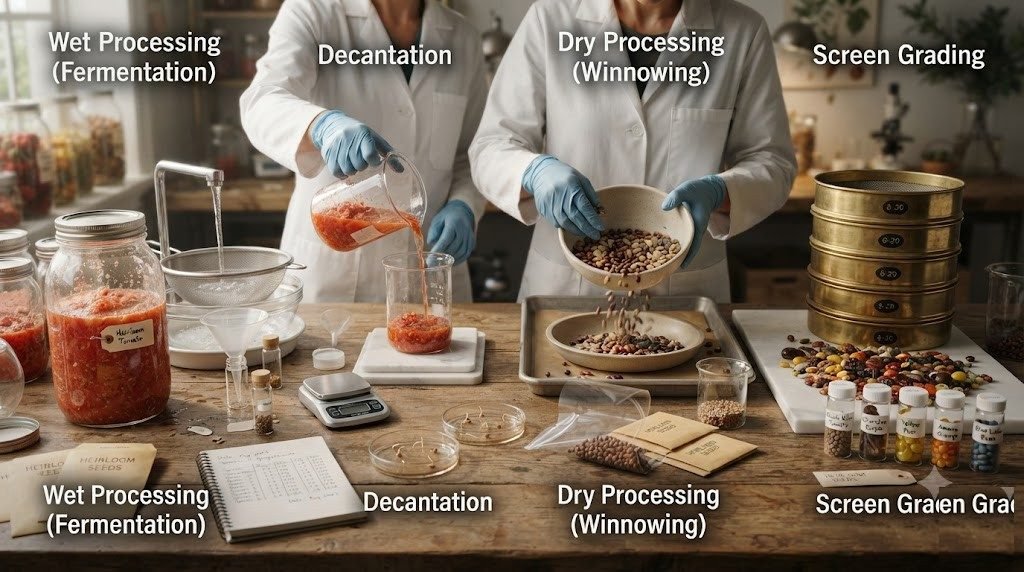
Harvesting mature zinnia, cosmos, and sunflower seeds yields massive volumes of lightweight chaff—including dried ray petals, disc floret bracts (chaff scales), and unfertilized, hollow seed hulls. Propagators utilize dual-screen grading: a 12-mesh upper screen captures coarse petal heads, while a 20-mesh lower screen retains plump, embryo-filled seeds while dropping fine pollen dust. Passing the screened seeds through a vertical air-column aspirator or electric fan winnowing drops dense, heavy seeds into the collection bin while lifting 100% of hollow hulls and petal fragments away.
Ornamental Seed Certification, Germination Standards, and Ecotype Genetics
The production, grading, and marketing of ornamental flower seeds encompass both highly refined F1 hybrid commercial cut-flower crops and regionally wild-collected native wildflower species. Commercial flower seed certification is guided by the Association of Official Seed Analysts (AOSA) and the Federal Seed Act, which mandate accurate labeling of pure seed percentage, inert matter (such as flower petal chaff or pappus silk), other crop seed, and germination test dates. In native wildflower propagation, seed standards place primary emphasis on genetic ecotype provenance—certifying that seed stocks originate from locally adapted wild populations within a defined geographic ecoregion (typically within 150 to 300 kilometers) to ensure ecological fitness with local soils, rainfall patterns, and native pollinator communities.
Seed laboratories classify ornamental flower seeds into three functional propagation categories:
- Standard Raw Seed: Cleaned, unpelleted seeds evaluated under standard blotter paper or rolled-towel germination tests per AOSA protocols.
- Precision Pelleted Seed: Micro-seeds (petunias, snapdragons, begonias) coated with dissolvable inert clay binders to standardize physical dimensions for automated vacuum drum mechanical transplanters.
- Primed Flower Seed: High-value seeds subjected to osmotic solution hydration (PEG priming) to initiate early metabolic Phase I and Phase II repair before drying, ensuring ultra-fast, synchronized field emergence within 48 to 72 hours of planting.
Wildflower Harvest Ethics and Conservation Biosecurity
In wild native seed collection, seed conservationists adhere strictly to the 1 in 20 Rule formulated by the Center for Plant Conservation (CPC) and the Kew Millennium Seed Bank. Collectors never harvest more than 5% to 10% of the mature seeds from any wild plant population in a single season, ensuring that the vast majority of seed falls naturally to regenerate the local habitat, nourish wild granivorous birds, and sustain the wild soil seed bank.
| Ornamental Flower Category | Primary Seed Quality Constraint | Standard Testing Methodology | Quality Benchmark |
|---|---|---|---|
| Native Prairie Wildflowers | High dormant seed fraction (morphophysiological). | Pre-chilled blotter test (30-day cold chill) + Tetrazolium assay. | Viability ≥ 75% (reported as % Germinated + % Hard Dormant). |
| Annual Cut Flowers (Zinnia/Cosmos) | Inert chaff contamination and hollow hulls. | Purity analysis + Air-column aspiration blower. | Pure seed ≥ 98%; germination capacity ≥ 85%. |
| Hard-Coated Ornamentals (Lupine) | Physical testa dormancy (water-impermeable). | Pre-scarified blotter test with 24-hr imbibition tracking. | Swollen seed imbibition ≥ 90% within 24 hours. |
| Dust-Seeded Flowers (Petunia/Foxglove) | Microscopic size; obligate light requirement. | Surface blotter assay under continuous 16-hr light at 22°C. | Germination ≥ 85%; pelleted seed dissolution < 30 seconds. |
Technical Frequently Asked Questions (FAQ)
What is the difference between ray floret seeds and disc floret seeds in zinnias?
A zinnia blossom is a composite flower head containing two distinct flower types: sterile or pistillate ray florets (which form the colorful outer petals) and bisexual disc florets (which form the tight central cone). Seeds harvested from ray florets are broad, shield-shaped, and rough, whereas seeds from disc florets are narrow, lanceolate, and dark. In double-flowered heirloom zinnias, ray floret seeds consistently produce a significantly higher percentage of fully double, densely petaled blooms, whereas disc floret seeds tend to revert to single or semi-double wild flower forms. Discerning flower farmers separate and sow ray floret seeds to maximize high-value double blooms.
How does mechanical scarification unlock germination in hard morning glory seeds?
Morning glory (Ipomoea spp.) and sweet pea (Lathyrus spp.) seeds have an outer seed coat (testa) sealed by a dense layer of wax-coated palisade sclereid cells (the Malpighian layer) that forms an absolute physical barrier to water and oxygen. Sowing unscarified seeds into moist soil often results in zero water absorption for months. Mechanical scarification—nicking the seed coat with a razor blade or rubbing seeds between sheets of sandpaper—physically ruptures this palisade barrier, allowing water to rush into the embryo via matric suction, causing the seed to swell to double its size and trigger radicle emergence in 48 to 72 hours.
Why must petunia and snapdragon seeds be sown strictly on the soil surface?
Petunia, snapdragon, and foxglove seeds are microscopic ‘dust seeds’ containing virtually zero stored endosperm carbohydrate reserves. If buried beneath even 2 millimeters of soil, the embryo lacks the energy reserves to push a shoot upward to the surface in darkness. Furthermore, these species are positively photoblastic: their internal germination biochemistry is activated by red light wavelengths detected by phytochrome photoreceptors. Direct light exposure triggers the synthesis of gibberellins that drive germination; darkness enforces permanent dormancy.
How does the outdoor winter sowing method work for native perennial wildflowers?
Winter sowing utilizes recycled translucent plastic milk jugs as passive solar mini-greenhouses set outdoors in mid-winter. Seeds are sown inside the moist soil of the jug, which is perforated for drainage and rain entry. During sub-zero winter nights, the soil freezes solid, fulfilling the seed’s cumulative cold moist stratification requirements (typically 30 to 60 days below 4°C). On sunny winter days, the jug warms up, creating natural freeze-thaw cycles that crack seed coats. When spring arrives, the mini-greenhouse warms, triggering early, robust germination of naturally cold-hardened seedlings that suffer zero transplant shock.
Breeding Novel Flower Colors and Open-Pollinated Selection
Annual cut flowers in the Asteraceae family—especially zinnias (Zinnia elegans) and cosmos (Cosmos bipinnatus)—are among the most playful and rewarding subjects for home plant breeding. Because they are open-pollinated and readily visited by bumblebees and butterflies, natural crosses occur constantly between adjacent varieties in a garden patch.
A home flower farmer can easily breed a signature custom flower strain through simple phenotypic roguing and recurrent mass selection:
- Sow a diverse blend of heirloom zinnia cultivars (e.g., mixing pastel ‘Queen Lime’, deep violet ‘Purple Prince’, and coral ‘Benary’s Giant’).
- As blooms open, immediately rogue out (cull and remove) any plants with muddy, undesirable colors, single wild petals, or susceptibility to powdery mildew.
- Allow only the most spectacular, densely doubled, disease-resistant blossoms to mature and set seed on the plant.
- Harvest seeds exclusively from these elite mother flowers. Within three to four seasons of recurrent selection, the grower stabilizes a unique, regionally adapted landrace strain with stunning custom coloration found nowhere in commercial seed catalogs.
Seed Harvesting Mechanics and Drying on Canvas Screens
To harvest seed from zinnias and sunflowers, allow flower heads to dry on the plant until the stem directly beneath the blossom turns straw-brown and brittle. Cut the dry seed heads on a sunny, low-humidity afternoon. Spread the heads in a single layer on elevated fine wire mesh drying screens inside a warm, airy shed for 10 to 14 days. Once dry, rub the heads between leather work gloves: seeds separate cleanly from the dried floral receptacles, ready for winnowing and hermetic glass storage.
Consistently saving seeds from the earliest blooming, strongest-stemmed individual flowers gradually acclimatizes the cultivar to local rainfall patterns, creating hardy heirloom cut-flower strains that outperform mass-market commercial seed packets. Furthermore, these open-pollinated floral stands provide abundant autumn forage for overwintering goldfinches and native pollinators, completing a balanced ecological cycle.
Saving seeds from composite cut flowers also deepens grower appreciation for botanical developmental stages, bridging garden aesthetics with long-term agricultural resilience.