Certain ornamental flowering plants produce seeds encased within armored, rock-hard seed coats designed to survive severe environmental adversity, drought, forest fires, and animal ingestion. Classic garden favorites in this category include morning glories and moonflowers (Ipomoea spp.), sweet peas (Lathyrus odoratus), hybrid perennial lupines (Lupinus polyphyllus), and canna lilies (Canna indica).
When sown straight from the commercial seed packet into damp soil, these hard-coated seeds frequently lie dormant for weeks, months, or even years without absorbing moisture. In botany, this phenomenon is defined as physical exogenous dormancy (testa-imposed dormancy). The outer seed coat (testa) is sealed by an impermeable layer of densely packed, wax-coated palisade sclereid cells (the Malpighian layer) that forms an absolute physical barrier to water vapor and liquid moisture. To unlock germination, the seed steward must physically compromise this armor through mechanical or thermal scarification.
🌱 The Water Uptake Imbibition Test
How can a gardener verify that scarification was successful? Perform the 24-Hour Imbibition Test: submerge scarified seeds in a dish of lukewarm water overnight. A properly scarified seed will absorb water rapidly through the compromised breach in its seed coat, swelling to double or triple its original physical size within 12 to 24 hours. Any seed that remains tiny, shriveled, and rock-hard after 24 hours has not been adequately breached and must be re-scarified.
Physical and Chemical Scarification Methodologies
Propagators utilize four distinct technical methodologies to breach hard seed coats without injuring the living embryo inside:
| Scarification Technique | Tools & Materials Utilized | Operational Procedure | Best Suited Flower Species |
|---|---|---|---|
| Mechanical Sandpaper Abrasion | Medium-grit sandpaper (120 – 150 grit) or emery board. | Rub seeds between two sandpaper sheets until the seed coat dulls and thins slightly. | Ideal for small hard seeds like Sweet Peas and Lupines. |
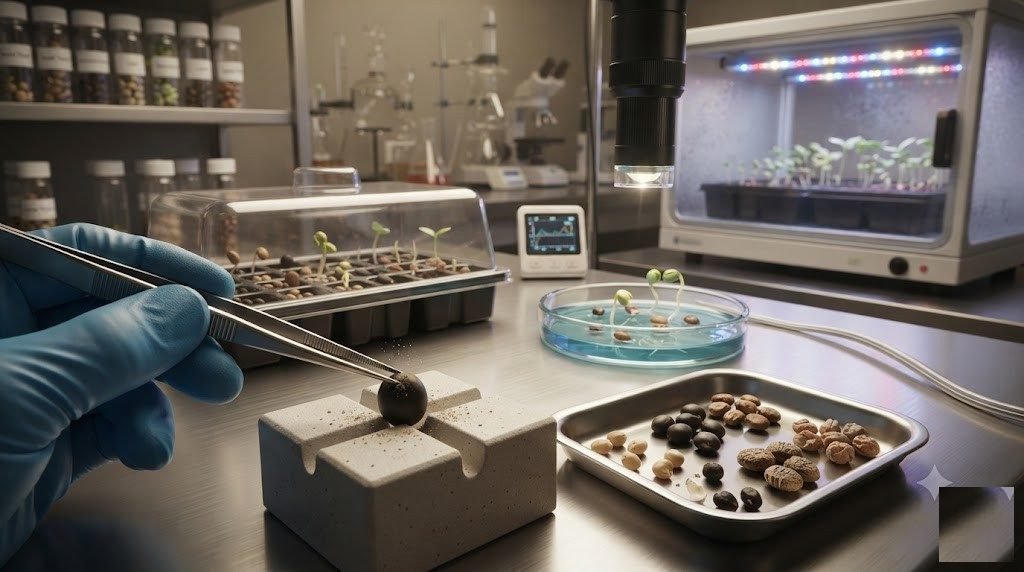
| Precision Razor Nicking | Sharp hobby knife (X-Acto) or nail clippers. | Nick a microscopic chip off the seed coat opposite the eye (hilum / micropyle). | Large seeds: Morning Glories, Moonflowers, Canna Lilies. |
| Hot Water Thermal Shock | Boiling water (100°C) poured over seeds; cool overnight. | Pour near-boiling water over seeds; allow to soak in cooling water for 18 to 24 hours. | Perennial Lupines, False Indigo (Baptisia), Redbud. |
| Sulfuric Acid Bath (Chemical) | Concentrated technical grade H2SO4 (10 to 20 min). | Submerge seeds in acid bath; neutralize in sodium bicarbonate; extensive water wash. | Large-scale commercial reclamation and nursery seed lots. |
Anatomical Landmarks: Avoiding the Hilum and Radicle
When performing manual mechanical nicking with a razor blade or nail clippers, anatomical precision is paramount. Every angiosperm seed possesses a visible scar termed the hilum (the attachment point to the maternal ovary wall) and a microscopic opening termed the micropyle. The embryonic root tip—the radicle—lies positioned directly beneath or adjacent to the micropyle.
If a gardener nicks the seed coat at the hilum or micropyle end, the steel blade will sever the embryonic radicle, killing the seed instantly. Mechanical nicking must strictly be executed on the outer convex shoulder or lateral edge of the seed, as far away from the hilum as possible, breaching only the dark outer testa without cutting into the creamy white internal cotyledons.
Testa Micromorphology: The Water-Impermeable Palisade Sclereid Layer
The rock-hard seed coat of morning glories (Ipomoea spp.), sweet peas (Lathyrus spp.), and lupines (Lupinus spp.) represents one of the most effective water-exclusion barriers in plant biology. Under cross-sectional microscopy, the outer seed coat reveals an extraordinarily dense, compact anatomical architecture:
- The Cuticle: A waxy, hydrophobic outer envelope composed of cross-linked cutin and suberin biopolymers that repels liquid water.
- The Macrosclereid (Malpighian) Layer: Columnar, vertically elongated palisade sclereid cells packed so tightly together that zero intercellular air spaces exist. Cell walls are heavily impregnated with hydrophobic suberin and lignified secondary thickening.
- The Light Line (Linea Lucida): An optical refractive band running through the upper third of the macrosclereid cells, representing a zone of extreme cellular compaction that blocks water molecules completely.
Until this physical palisade layer is mechanically ruptured, the seed can remain submerged in cold water for months without absorbing a single drop of moisture.
🌱 The Water Uptake Imbibition Curve in Scarified vs. Unscarified Seeds
When unscarified lupine seeds are placed in water, their mass remains 100% constant over 72 hours. However, when a microscopic notch is filed through the outer palisade layer, matric water potential drives explosive water imbibition: the seed mass increases by 120% to 150% in just 12 hours, the seed coat wrinkles and expands, and the creamy white cotyledons swell visibly, initiating mitochondrial respiration and protein synthesis.
Mechanical Razor Nicking vs. Sandpaper Drum Tumble Scarification
For home gardeners handling small batches of morning glory or sweet pea seeds, precision manual razor nicking or nail-clipper chipping on the lateral shoulder opposite the hilum provides 100% reliable results. However, for commercial flower farms handling tens of thousands of seeds, manual nicking is economically impossible.
Commercial seed houses utilize rotary sandpaper tumble scarification: seeds are loaded inside a rotating hexagonal drum lined with industrial silicon carbide abrasive paper (100 to 120 grit). The drum is rotated at 60 RPM for 15 to 30 minutes; centrifugal tumbling rubs the seeds against the abrasive walls, abrading the outer cuticle and thinning the palisade sclereids uniformly without cracking internal cotyledons. When followed by a 12-hour soak, scarified seed lots achieve 90%+ synchronized emergence.
Ornamental Seed Certification, Germination Standards, and Ecotype Genetics
The production, grading, and marketing of ornamental flower seeds encompass both highly refined F1 hybrid commercial cut-flower crops and regionally wild-collected native wildflower species. Commercial flower seed certification is guided by the Association of Official Seed Analysts (AOSA) and the Federal Seed Act, which mandate accurate labeling of pure seed percentage, inert matter (such as flower petal chaff or pappus silk), other crop seed, and germination test dates. In native wildflower propagation, seed standards place primary emphasis on genetic ecotype provenance—certifying that seed stocks originate from locally adapted wild populations within a defined geographic ecoregion (typically within 150 to 300 kilometers) to ensure ecological fitness with local soils, rainfall patterns, and native pollinator communities.
Seed laboratories classify ornamental flower seeds into three functional propagation categories:
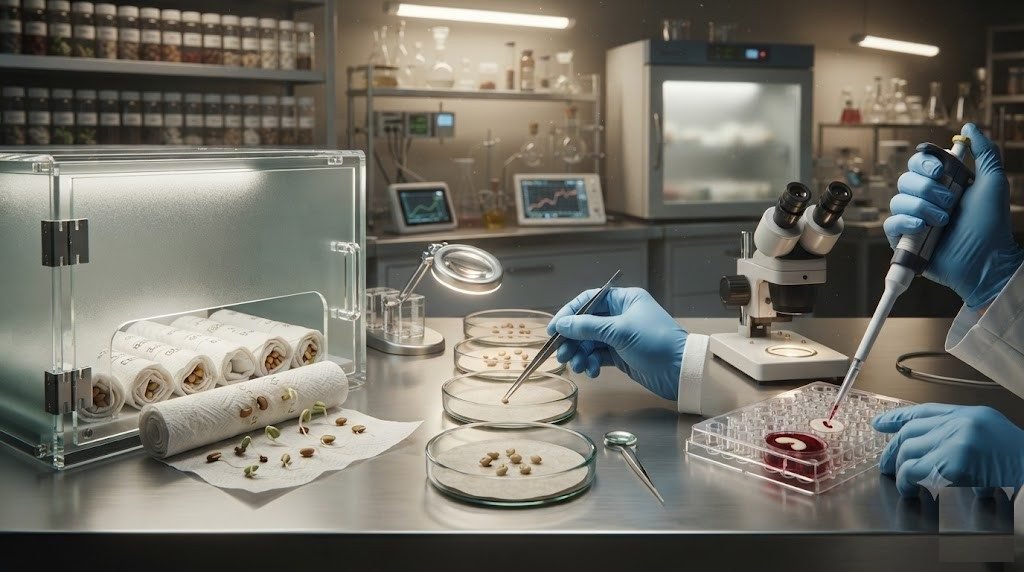
- Standard Raw Seed: Cleaned, unpelleted seeds evaluated under standard blotter paper or rolled-towel germination tests per AOSA protocols.
- Precision Pelleted Seed: Micro-seeds (petunias, snapdragons, begonias) coated with dissolvable inert clay binders to standardize physical dimensions for automated vacuum drum mechanical transplanters.
- Primed Flower Seed: High-value seeds subjected to osmotic solution hydration (PEG priming) to initiate early metabolic Phase I and Phase II repair before drying, ensuring ultra-fast, synchronized field emergence within 48 to 72 hours of planting.
Wildflower Harvest Ethics and Conservation Biosecurity
In wild native seed collection, seed conservationists adhere strictly to the 1 in 20 Rule formulated by the Center for Plant Conservation (CPC) and the Kew Millennium Seed Bank. Collectors never harvest more than 5% to 10% of the mature seeds from any wild plant population in a single season, ensuring that the vast majority of seed falls naturally to regenerate the local habitat, nourish wild granivorous birds, and sustain the wild soil seed bank.
| Ornamental Flower Category | Primary Seed Quality Constraint | Standard Testing Methodology | Quality Benchmark |
|---|---|---|---|
| Native Prairie Wildflowers | High dormant seed fraction (morphophysiological). | Pre-chilled blotter test (30-day cold chill) + Tetrazolium assay. | Viability ≥ 75% (reported as % Germinated + % Hard Dormant). |
| Annual Cut Flowers (Zinnia/Cosmos) | Inert chaff contamination and hollow hulls. | Purity analysis + Air-column aspiration blower. | Pure seed ≥ 98%; germination capacity ≥ 85%. |
| Hard-Coated Ornamentals (Lupine) | Physical testa dormancy (water-impermeable). | Pre-scarified blotter test with 24-hr imbibition tracking. | Swollen seed imbibition ≥ 90% within 24 hours. |
| Dust-Seeded Flowers (Petunia/Foxglove) | Microscopic size; obligate light requirement. | Surface blotter assay under continuous 16-hr light at 22°C. | Germination ≥ 85%; pelleted seed dissolution < 30 seconds. |
Technical Frequently Asked Questions (FAQ)
What is the difference between ray floret seeds and disc floret seeds in zinnias?
A zinnia blossom is a composite flower head containing two distinct flower types: sterile or pistillate ray florets (which form the colorful outer petals) and bisexual disc florets (which form the tight central cone). Seeds harvested from ray florets are broad, shield-shaped, and rough, whereas seeds from disc florets are narrow, lanceolate, and dark. In double-flowered heirloom zinnias, ray floret seeds consistently produce a significantly higher percentage of fully double, densely petaled blooms, whereas disc floret seeds tend to revert to single or semi-double wild flower forms. Discerning flower farmers separate and sow ray floret seeds to maximize high-value double blooms.
How does mechanical scarification unlock germination in hard morning glory seeds?
Morning glory (Ipomoea spp.) and sweet pea (Lathyrus spp.) seeds have an outer seed coat (testa) sealed by a dense layer of wax-coated palisade sclereid cells (the Malpighian layer) that forms an absolute physical barrier to water and oxygen. Sowing unscarified seeds into moist soil often results in zero water absorption for months. Mechanical scarification—nicking the seed coat with a razor blade or rubbing seeds between sheets of sandpaper—physically ruptures this palisade barrier, allowing water to rush into the embryo via matric suction, causing the seed to swell to double its size and trigger radicle emergence in 48 to 72 hours.
Why must petunia and snapdragon seeds be sown strictly on the soil surface?
Petunia, snapdragon, and foxglove seeds are microscopic ‘dust seeds’ containing virtually zero stored endosperm carbohydrate reserves. If buried beneath even 2 millimeters of soil, the embryo lacks the energy reserves to push a shoot upward to the surface in darkness. Furthermore, these species are positively photoblastic: their internal germination biochemistry is activated by red light wavelengths detected by phytochrome photoreceptors. Direct light exposure triggers the synthesis of gibberellins that drive germination; darkness enforces permanent dormancy.
How does the outdoor winter sowing method work for native perennial wildflowers?
Winter sowing utilizes recycled translucent plastic milk jugs as passive solar mini-greenhouses set outdoors in mid-winter. Seeds are sown inside the moist soil of the jug, which is perforated for drainage and rain entry. During sub-zero winter nights, the soil freezes solid, fulfilling the seed’s cumulative cold moist stratification requirements (typically 30 to 60 days below 4°C). On sunny winter days, the jug warms up, creating natural freeze-thaw cycles that crack seed coats. When spring arrives, the mini-greenhouse warms, triggering early, robust germination of naturally cold-hardened seedlings that suffer zero transplant shock.
Alkaloid Chemistry and Ecological Toxicity in Hard-Coated Seeds
The thick, impenetrable seed coats of morning glories (Ipomoea spp.) and perennial lupines (Lupinus spp.) serve not only as physical barriers against moisture, but as armored storage vaults for potent chemical defenses. In wild morning glory seeds, the embryo tissues contain natural ergoline alkaloids (such as ergine and lysergic acid amide / LSA), which confer an intensely bitter taste and induce toxic central nervous system symptoms in seed-eating birds and rodents.
Similarly, lupine seeds contain bitter quinolizidine alkaloids (lupinine and sparteine) that protect the high-protein seeds from mammalian herbivores. When handling hard-coated flower seeds during manual razor nicking or sandpaper tumbling, propagators should wear clean nitrile gloves and avoid touching eyes or mouth, washing hands thoroughly after seed preparation.
Rapid In-Ground Establishment Following Thermal Hot-Water Priming
For large-scale plantings of hard-coated seeds where manual razor nicking is too tedious, the boiling water thermal shock protocol provides excellent batch scarification:
- Bring a pot of clean water to a rolling boil (100°C / 212°F), then immediately remove the pot from the heat source.
- Pour the near-boiling water over the dry seeds in a heat-resistant glass bowl (using approximately 5 parts water to 1 part seeds by volume).
- Allow the seeds to sit undisturbed in the cooling water as it gradually reaches room temperature over 18 to 24 hours.
The initial thermal shock fissures the outer waxy cuticle and softens the palisade sclereid cells without cooking the embryo inside. Within 12 hours, seeds absorb water and swell dramatically, ready for immediate planting into warm, well-prepared garden soil.
Direct-seeding pre-swollen lupine and sweet pea seeds into cool spring soil ensures rapid taproot establishment before summer heat, producing vigorous floral spikes with dense pollinator visitation. This dual physical and thermal conditioning establishes uniform floral stands capable of flourishing in challenging clay soils.