The botanical subgenus Prunus—encompassing stone fruits such as peaches, nectarines, plums, apricots, and sweet and sour cherries—produces some of the most robust, armored seeds in the plant kingdom. Botanically, the fruit of a Prunus species is classified as a drupe: a fleshy outer mesocarp enclosing a hard, heavily lignified protective inner shell termed the endocarp (the pit or stone), which safely houses the delicate true seed kernel inside.
Propagating stone fruits from seed presents a double botanical barrier: first, a severe mechanical physical dormancy imposed by the thick, stone-hard endocarp that physically restrains embryo expansion and impedes water imbibition; and second, a profound internal physiological dormancy within the kernel embryo that requires extensive cumulative winter chilling hours to break.
🌱 The Mechanics of Endocarp Lignification
The stone fruit pit is composed of specialized sclerenchyma cells with thick secondary cell walls heavily impregnated with lignin—the same structural biopolymer that gives hardwoods their compressive strength. In nature, this stone endocarp requires several seasons of microbial soil fungal decay, moisture freeze-thaw cycles, and mechanical soil pressure to crack open along its natural fused suture line, allowing water to penetrate the interior seed kernel.
Manual Endocarp Cracking versus Natural Freeze-Thaw Stratification
To bypass years of waiting for natural soil weathering, seed propagators deploy two distinct processing strategies:
| Methodology | Technical Procedure | Chilling Duration Required | Germination Success & Risk Profile |
|---|---|---|---|
| Manual Mechanical Vise Cracking | Carefully compress pit in bench vise or clamp parallel to suture line until pit pops open; extract intact kernel. | 60 to 90 days cold stratification for extracted kernel. | High speed (single season); risk of crushing or nicking fragile internal embryo if pressure is misapplied. |
| Warm / Cold Sequential Cycling | Soak intact pits in warm water (25°C) for 14 days, followed by outdoor winter buried sand bed stratification. | 90 to 150 days natural winter freeze-thaw cycles. | Completely zero risk of embryo damage; mimics nature perfectly but demands longer patience. |
| Outdoor Fall In-Ground Sowing | Plant clean, uncracked pits 5 cm deep in protected outdoor nursery beds in late autumn; mulch heavily. | Natural winter chill hours fulfilled in situ. | Produces exceptionally hardy seedling root emergence in spring; requires rodent wire mesh cages. |
Chilling Hours and Gibberellic Acid (GA3) Interventions
Extracted stone fruit kernels must accumulate between 800 and 1,200 chill hours (temperatures strictly between 1°C and 5°C / 34°F – 41°F) under damp, well-aerated conditions before seedling radicles will emerge. If seeds are subjected to sub-freezing temperatures (< 0°C), internal metabolic dormancy-breaking processes halt completely; if temperatures exceed 8°C, accumulated chilling hours can be enzymatically erased (de-stratification).
In professional botanical nurseries, propagators frequently treat extracted peach and plum kernels with a 24-hour soak in a 250 to 500 ppm solution of gibberellic acid (GA3) prior to cold stratification. The exogenous gibberellin supplements the embryo’s endogenous hormone production, accelerating dormancy release and shortening mandatory stratification times by up to 40%.
Endocarp Sclerenchyma Anatomy and Lignocellulosic Suture Physics
The protective pit of a stone fruit is an anatomical marvel of structural botany. Formed from the inner layer of the ovary wall, the endocarp consists of multi-layered sclerenchyma tissue where cells have undergone secondary wall thickening, developing branched pits and dense lignocellulosic matrices. What appears as a monolithic stone is actually two symmetrical halves fused along a prominent longitudinal suture line.
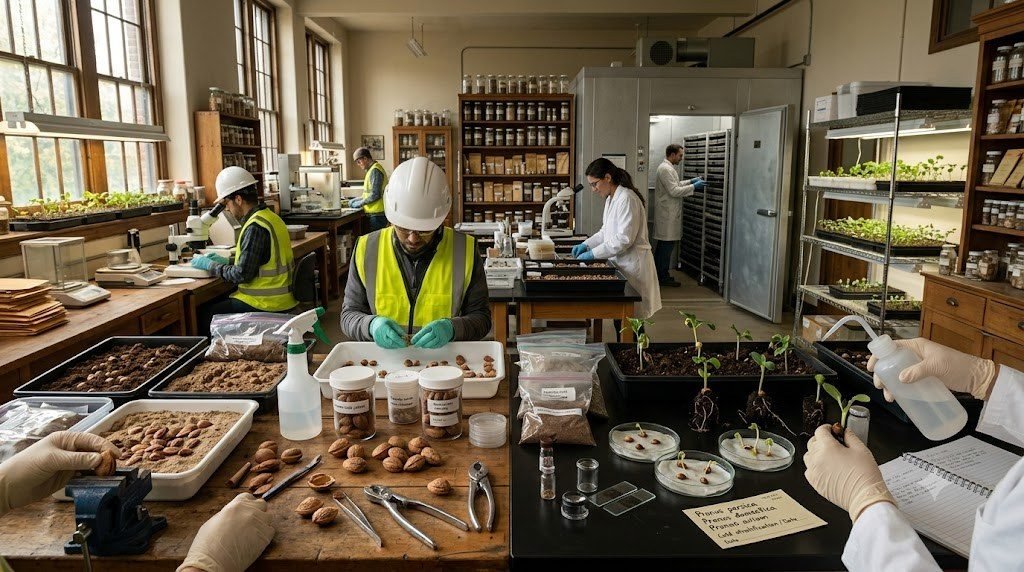
Under natural conditions, moisture slowly penetrates microscopic micro-capillaries along this suture line. During winter freeze-thaw cycles, liquid water inside these microscopic crevices freezes, expanding by 9% in physical volume. This hydraulic freezing pressure acts as a microscopic wedge, applying continuous tensile stress that progressively widens the suture fissure. In laboratory preparation, applying controlled mechanical pressure in a bench vise parallel to this suture line pops the pit open cleanly without crushing the soft, edible kernel within.
🌱 Cyanogenic Glycosides: Amygdalin and Seed Chemical Defense
The internal kernels of peaches, bitter almonds, apricots, and plums contain high concentrations of amygdalin—a cyanogenic glycoside consisting of a benzaldehyde molecule and two glucose units bound to a cyanide group. In the intact seed, amygdalin is sequestered inside cellular vacuoles, while the enzyme β-glucosidase is stored separately in the cytoplasm. If a rodent or herbivorous insect bites into the seed kernel, the cell walls break, bringing the enzyme and glycoside into contact to release toxic hydrogen cyanide (HCN) gas, delivering instant chemical defense against seed predation.
Warm-Cold Stratification Cycling Mechanics for Plum and Cherry Seeds
While peaches and apricots typically require only simple moist cold stratification (60 to 90 days), wild plums (Prunus americana) and sweet and sour cherries (Prunus avium and Prunus cerasus) exhibit complex epicotyl and double morphophysiological dormancy. If subjected solely to cold temperatures, germination rarely exceeds 15%.
Propagators deploy a sequential warm-then-cold stratification protocol:
- Warm Phase (Embryo Maturation): Clean seeds are packed in moist sterile sand and held at 20°C to 24°C (68°F – 75°F) for 30 to 45 days. The warm moisture softens the inner seed coat, allows the underdeveloped embryo to expand, and enables soil microbes to break down surface germination inhibitors.
- Cold Phase (Chilling Accumulation): The flats are transferred to a cold refrigerator (2°C – 4°C / 36°F – 39°F) for 90 to 120 days. The cold temperature activates gibberellin synthesis and degrades abscisic acid, priming the radicle for rapid spring emergence.
Underfloor Potting and Taproot Air-Pruning Design
Stone fruit seedlings develop rapid, thick primary taproots that can elongate 15 to 20 cm before the first true leaves even expand above the soil line. If germinated in standard shallow nursery flats, the taproot hits the plastic bottom, coils tightly around the container, and forms permanent ‘J-root’ deformities that cause mature trees to blow over in high winds decades later. Propagators germinate stone fruits in deep air-pruning tree tubes or bottomless bottom-mesh pots: when the taproot reaches the open air at the container base, the root tip naturally dehydrates and self-prunes, stimulating a dense, fibrous root architecture ideal for field transplanting.
Fruit Seed Propagation Standards, USDA Guidelines, and Rootstock Certification
The propagation of fruit trees and berry crops from botanical seed occupies a specialized niche within commercial pomology and agroforestry. Unlike commercial orchard scion varieties that are cloned via dormant budding or grafting to preserve specific dessert fruit characteristics, fruit seeds are propagated primarily for two essential agricultural purposes: the mass production of robust, deep-rooted seedling rootstocks, and the breeding of novel, climate-resilient cultivars. In the United States, fruit rootstock seed production complies with USDA-APHIS guidelines and the California Fruit Tree Rootstock Certification Program to ensure freedom from debilitating viral pathogens such as Prunus Necrotic Ringspot Virus (PNRSV) and Apple Mosaic Virus (ApMV).
Fruit seed testing follows specialized protocols established by the International Seed Testing Association (ISTA):
- Excised Embryo Testing: Because deeply dormant pome and stone fruit seeds require months of cold stratification before standard germination occurs, ISTA authorizes excised embryo assays. Technicians surgically remove the embryo from its seed coat and culture it on sterile moist blotters at 22°C: viable embryos green up and expand within 5 to 7 days, providing rapid viability confirmation.
- Tetrazolium Viability Verification: Pome and stone fruit embryos are bisected longitudinally and stained with 1% triphenyl tetrazolium chloride to evaluate mitochondrial dehydrogenase activity across the radicle axis and cotyledons.
- Sub-Zero Cold Tolerance Standards: Pome and stone fruit rootstock seed lots are certified according to their cold-hardiness zone compatibility, verifying genetic adaptation to winter ground freezes down to -35°C.
Biosecurity and Citrus Tristeza Virus (CTV) Quarantine Regulations
In citrus seed propagation, biosecurity regulations are extraordinarily stringent. Citrus Tristeza Virus (CTV) and the devastating bacterial disease Huanglongbing (HLB / Citrus Greening, vectored by the Asian citrus psyllid) have decimated commercial citrus groves across Florida and California. State departments of agriculture strictly prohibit the interstate transport or personal mailing of non-certified citrus seeds and budwood.
| Fruit Crop Group | Critical Quarantined Pathogen | Transmission Pathway | Mandatory Certification Protocol |
|---|---|---|---|
| Citrus (Oranges/Lemons) | Citrus Greening (HLB) / Citrus Tristeza (CTV) | Infected vegetative tissue and seed-coat sap. | Mandatory USDA-APHIS certified disease-free foundation mother blocks; thermotherapy. |
| Stone Fruits (Prunus) | Plum Pox Virus (Sharka / PPV) | Aphid vectors and seed transmission in wild Prunus. | ELISA testing of maternal parent trees; quarantine border inspections. |
| Pome Fruits (Apples/Pears) | Fire Blight (Erwinia amylovora) | Bacterial entry through floral nectaries into seed cavity. | Seed sanitation in 10% sodium hypochlorite or streptomycin wash. |
| Small Berries (Fragaria/Rubus) | Tomato Ringspot Virus (ToRSV) | Nematode vectors and pollen/seed transmission. | Foundation stock grown under insect-proof screenhouses in sterile soil media. |
Technical Frequently Asked Questions (FAQ)
Why don’t apple seeds grow into the exact same apple variety that was eaten?
Apples (Malus domestica) are extreme genetic heterozygotes. Every apple flower possesses self-incompatibility genes that prevent it from being fertilized by its own pollen; it must be cross-pollinated by an entirely different apple or crabapple tree. As a consequence of sexual reproduction and chromosomal recombination, the seeds inside a single Honeycrisp apple carry thousands of shuffled genes. Planting an apple seed will produce an entirely new, never-before-seen variety of apple. Only about one in 10,000 apple seedlings produces a fruit with commercial dessert quality; the vast majority yield tart, astringent, or hard apples historically prized for fermented hard cider or livestock feed.
How does a seed saver identify a nucellar citrus seedling from a sexual seedling?
In polyembryonic citrus seeds, multiple seedlings emerge from a single seed. Nucellar seedlings are asexual maternal clones: they inherit 100% of the mother tree’s genetics and display intense vegetative vigor, rapid upright growth, uniform green stems, and classic maternal leaf aromatics when crushed. By contrast, the single sexual (zygotic) seedling is often smaller, weaker, and may display variable leaf shapes, variegated foliage, or unusual spininess. Commercial rootstock nursery managers selectively cull the stunted or aberrant sexual seedlings, saving only the vigorous, identical nucellar clones.
Can stone fruit pits be planted directly outdoors in the autumn instead of using a refrigerator?
Yes, planting stone fruit pits outdoors in late autumn (October to November) is the traditional, natural method of propagation. Outdoor fall sowing allows natural winter snow, freezing rain, and soil freeze-thaw cycles to satisfy the seed’s cold stratification requirements (800 to 1,200 chill hours) in situ, while soil moisture and natural soil microbes slowly soften the lignified endocarp. However, outdoor seed beds must be protected with hardware cloth or heavy wire mesh buried 15 cm deep to prevent squirrels, chipmunks, and field mice from digging up and consuming the nutrient-dense kernels during winter.
What substrate is best for germinating acid-loving berry seeds like blueberries?
Blueberry (Vaccinium spp.) seeds require an extremely acidic, well-aerated, low-nutrient substrate with a pH strictly between 4.2 and 4.8. Standard potting soils (pH 6.2 – 6.8) contain excessive calcium and fertilizer salts that burn delicate blueberry root tips and induce fatal iron chlorosis. Propagators use 100% finely milled, unfertilized Canadian sphagnum peat moss moistened with distilled water or rainwater. Seeds are sown on the surface under bright fluorescent or LED grow lights and kept continuously moist using humidity domes and capillary bottom watering.
Rootstock Vigorous Adaptation to Saline and Calcareous Soils
Propagating stone fruit trees from seed yields exceptional rootstocks with broad environmental adaptability. While commercial clonal rootstocks often fail in difficult, heavy alkaline clays, seedling stone fruits—particularly wild American plums (Prunus americana) and seedling peaches (Prunus persica cv. ‘Lovell’ or ‘Bailey’)—exhibit natural genetic variation that enables individual seedlings to tolerate high soil pH, heavy limestone subsoils, and moderate groundwater salinity.
The deep, multi-tiered root architecture developed by seedling stone fruits establishes vigorous symbiotic associations with native vesicular-arbuscular mycorrhizal (VAM) fungi. These fungal networks expand the effective root surface area by up to 1,000%, enhancing phosphorus uptake in nutrient-poor soils and conferring extraordinary drought resilience during prolonged summer dry spells without supplemental irrigation.
Furthermore, seedling stone fruits preserve vital genetic defenses against bacterial canker (Pseudomonas syringae) and root-knot nematodes (Meloidogyne spp.), providing a resilient foundation for organic agroforestry orchards without chemical soil fumigation. Selecting hardy regional seedlings also stabilizes fruit production against unseasonal late-winter thaws and sudden sub-zero polar vortex events.