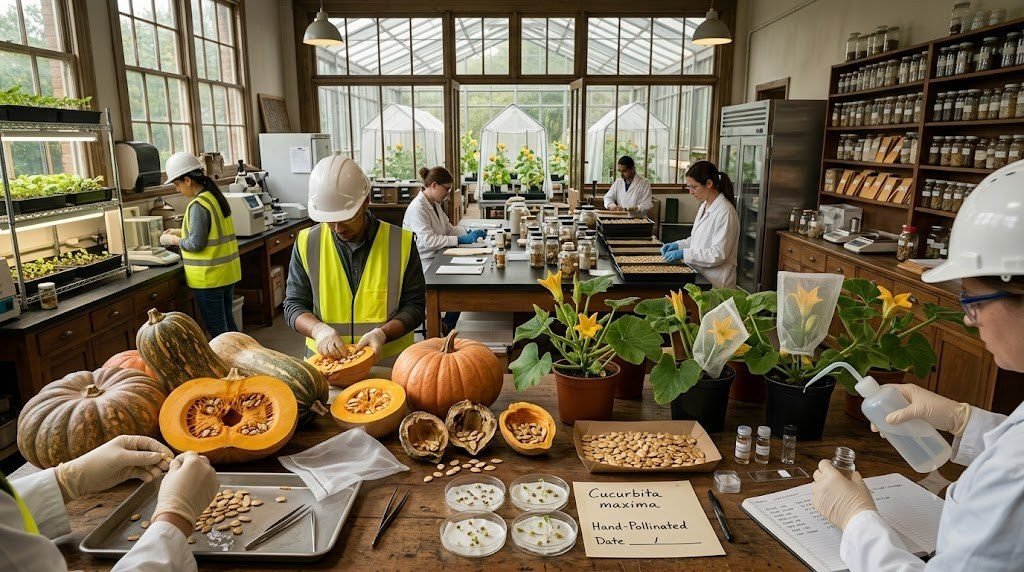
The vine-growing family Cucurbitaceae—encompassing winter squash, summer squash, pumpkins, cucumbers, watermelons, and cantaloupes—produces some of the most generous seed yields in the home garden. A single mature butternut squash or heirloom melon fruit can yield several hundred plump, nutrient-dense seeds capable of maintaining germination viability for five to six years under proper storage.
However, cucurbits present unique challenges to genetic purity. Unlike self-fertile tomatoes or legumes, almost all cultivated cucurbits are monoecious: an individual vine bears separate male (staminate) and female (pistillate) blossoms. Pollen grains are large, sticky, and cannot be transported by wind; pollination relies entirely on foraging bees (including specialized squash bees, Peponapis and Xenoglossa spp.). Because bees routinely forage across a 1-to-2-mile radius, cucurbit varieties cross-pollinate with extraordinary ease unless the grower intervenes through controlled hand-pollination.
🌱 De-Bunking Cucurbit Cross-Pollination Myths
A persistent garden myth asserts that growing cucumbers next to melons will ruin the flavor of this season’s melon fruit. This is botanically impossible! The flesh of the fruit develops entirely from maternal ovary tissue; cross-pollination only affects the genetics stored inside the seed embryo. Unintended crossing will only manifest when those harvested seeds are sown in the following gardening season.
Hand-Pollination and Blossom Bagging Step-by-Step
To guarantee 100% varietal trueness without maintaining unrealistic half-mile isolation buffers in suburban neighborhoods, seed savers deploy manual blossom taping and hand-pollination:
| Sequential Stage | Timing & Operational Window | Horticultural Action | Biochemical & Physical Objective |
|---|---|---|---|
| Blossom Identification | Evening prior to anthesis (blooming). | Identify mature male and female flower buds that show yellow petal tips. | Blossoms must be intercepted before sunrise when pollinating insects become active. |
| Blossom Taping / Bagging | Late dusk (approx. 7:00 – 8:30 PM). | Gently tape petal tips shut with paper masking tape or slip organza jewelry bags over buds. | Physically prevents squash bees from entering and depositing foreign pollen. |
| Morning Hand-Pollination | Early morning (6:30 – 9:00 AM). | Remove tape from male flower; peel petals back to expose anther column; dust golden pollen generously over female stigma. | Executes targeted genetic cross-fertilization during peak stigma receptivity window. |
| Re-Sealing & Tagging | Immediately following pollination. | Re-tape female flower petals shut; tie bright surveyor flagging tape around the stem peduncle. | Prevents post-pollination insect contamination and permanently marks fruit for seed harvest. |
| After-Ripening & Curing | Harvest at full vine senescence; cure 3 weeks. | Store harvested squash at 20°C (68°F) before scooping seeds. | Allows seed coat lignification and embryo maturation to complete inside maternal cavity. |
The Four Distinct Cucurbita Species Classifications
To plan garden layouts effectively, growers must recognize that cultivated squashes and pumpkins belong to four distinct, non-interbreeding botanical species:
- Cucurbita pepo: Zucchini, yellow crookneck, acorn squash, pattypan, and traditional carving pumpkins (stem: hard, deeply 5-ridged, pentagonal).
- Cucurbita moschata: Butternut squash, Long Island Cheese pumpkin, and Seminole pumpkin (stem: hard, smooth, flared widely at fruit junction).
- Cucurbita maxima: Hubbard, Kabocha, Buttercup, and giant Atlantic pumpkins (stem: soft, spongy, corky, perfectly cylindrical).
- Cucurbita argyrosperma: Cushaw squashes, grown predominantly in the American South for edible pepita seeds (stem: hard, angular, moderately flared).
Crucially, varieties belonging to different species will not cross-pollinate in the garden. A gardener can safely grow a Butternut (C. moschata) directly adjacent to a Zucchini (C. pepo) without bagging blossoms, and harvest genetically pure seed from both!
Monoecious Sex Expression and Phytohormone Regulation in Cucurbits
In the family Cucurbitaceae, floral organ differentiation is not genetically fixed by sex chromosomes; rather, it is dynamically regulated by endogenous phytohormones interacting with photoperiod and temperature. The female flower (distinguished by the inferior ovary resembling a miniature fruit at the base of the petals) and the male flower (borne on a slender erect stalk) respond in opposite directions to environmental cues:
- Ethylene Biosynthesis: High endogenous ethylene levels promote female pistillate flower formation. Cool night temperatures (15°C – 18°C) and short photoperiods stimulate ethylene synthesis, shifting the male-to-female floral ratio toward heavy fruit set.
- Gibberellin Biosynthesis: High gibberellin concentrations promote male staminate flower production. Prolonged summer heatwaves (> 32°C / 90°F) and long days trigger male flower surges, often causing frustrating 2-to-3-week periods where vines produce dozens of male blossoms without a single female bud.
🌱 Squash Bee (Peponapis pruinosa) Pollination Dynamics
While honeybees visit squashes incidentally, the primary wild pollinator of native North American cucurbits is the solitary ground-nesting squash bee (Peponapis pruinosa). Female squash bees emerge from subterranean burrows in the soil directly beneath squash vines at the crack of dawn—often 30 to 45 minutes before sunrise—when cucurbit blossoms first open. They forage exclusively on cucurbit pollen, completing pollination before honeybee hives even awaken.
Post-Harvest Cavity Curing and Embryo Endosperm Maturation
A common error in squash seed saving is extracting seeds immediately upon severing the fruit from the vine. At the moment of physical harvest (even when the exterior rind has hardened and stems have corked), the seeds inside the central seed cavity have not completed physiological maturation. The embryonic cotyledons are still absorbing mobile carbohydrates and lipid reserves from the vascular placental strands connecting them to the maternal fruit wall.
Winter squashes (Cucurbita maxima and Cucurbita moschata) must undergo a post-harvest curing duration of 20 to 30 days in a warm, dry room maintained at 20°C to 24°C (68°F – 75°F) with good ventilation. During this curing window:
- Soluble sugars within the placental tissue migrate into the seed embryo, synthesizing dense storage proteins (cucurbitins).
- The outer seed coat (testa) completes lignification, developing a hard, protective, pale cream outer shell.
- Total seed dry weight increases by 12% to 18%, and germination capacity rises from ~60% up to 95%+.
Toxic Squash Syndrome and Cucurbitacin Gene Expression
Wild ancestral cucurbits contain high concentrations of cucurbitacins—extremely bitter, highly toxic tetracyclic triterpenoid biochemical compounds that act as natural insect repellents. Cultivated domestic squashes have been bred for recessive non-bitter genes. However, if a domestic zucchini crosses with a wild ornamental gourd (which also belongs to Cucurbita pepo), the resulting progeny will inherit dominant cucurbitacin synthesis genes, producing fruit so intensely bitter that consuming a few bites can induce violent gastrointestinal illness (toxic squash syndrome). Controlled hand-pollination is essential to prevent wild gourd gene introgression.
Regulatory Standards, ISTA Protocols, and Seed Certification
The commercial distribution and genetic conservation of vegetable seed stocks are governed by comprehensive international and national legal standards. In the United States, the Federal Seed Act (7 U.S.C. 1551) and individual state seed laws enforce minimum germination standards, noxious weed seed tolerances, and varietal trueness labeling. Internationally, the International Seed Testing Association (ISTA) and the Association of Official Seed Analysts (AOSA) publish standardized laboratory protocols for measuring seed purity, moisture content, and germination percentages.
For commercial certified seed production, seed lots must satisfy rigorous four-tier certification standards established by the Association of Official Seed Certifying Agencies (AOSCA):
- Breeder Seed: The highest genetic tier, directly controlled by the originating plant breeder or university agricultural experiment station, guaranteeing 100% varietal purity.
- Foundation Seed: Produced from breeder seed and maintained by agricultural universities or foundation seed organizations under maximum spatial isolation.
- Registered Seed: The progeny of foundation seed, carefully managed to maintain satisfactory genetic identity and purity for commercial multiplication.
- Certified Seed: The final commercial tier sold to farmers and home growers, certified to meet statutory minimum germination percentages (typically ≥ 75% for cucurbits and legumes; ≥ 80% for tomatoes and brassicas) and zero tolerance for designated noxious weed seeds.
Seed Health, Phytosanitary Testing, and Pathogen Exclusion
Seed-borne plant pathogens—including bacterial canker (Clavibacter in tomatoes), black rot (Xanthomonas campestris in brassicas), and anthracnose (Colletotrichum in beans)—can devastate entire agricultural regions if infected seed lots are shipped across borders. Certified seed laboratories deploy molecular diagnostic testing—including Polymerase Chain Reaction (PCR) assays, enzyme-linked immunosorbent assays (ELISA), and agar plating—to verify that seed lots are certified pathogen-free prior to issuing USDA-APHIS phytosanitary export certificates.
| Crop Family | Primary Seed-Borne Pathogen | Diagnostic Assay | Sanitation / Quarantine Benchmark |
|---|---|---|---|
| Solanaceae (Tomatoes) | Clavibacter michiganensis (Bacterial Canker) | Immunofluorescence / PCR | Zero tolerance; 48-hr fermentation or hot water treatment at 50°C for 25 min. |
| Brassicaceae (Cabbage/Kale) | Xanthomonas campestris (Black Rot) | Liquid plating on mCS20AB media | Zero tolerance; hot water treatment at 50°C (122°F) for 20 minutes. |
| Cucurbitaceae (Melons/Squash) | Acidovorax citrulli (Bacterial Fruit Blotch) | Seedling grow-out PCR assay (30,000 seeds) | Zero visual symptoms in 30,000 seedling greenhouse grow-out test. |
| Fabaceae (Beans/Peas) | Pseudomonas savastanoi (Halo Blight) | Agar dilution plating | Field roguing of infected plants; seed harvest strictly from disease-free fields. |
Technical Frequently Asked Questions (FAQ)
Why is hot water seed treatment recommended for brassica and tomato seeds?
Hot water treatment is a non-chemical thermotherapeutic protocol that eradicates internal and external seed-borne bacterial pathogens (such as bacterial canker, black rot, and bacterial spot) without harming seed viability. Seeds are submerged in precisely calibrated hot water (50°C / 122°F) for 20 to 25 minutes using a thermostatically controlled circulating water bath. The heat penetrates the seed coat, denaturing bacterial proteins while remaining just below the thermal death threshold of the plant embryo. Water temperatures must be monitored with ±0.5°C precision, as higher temperatures kill the embryo and lower temperatures fail to eliminate bacteria.
What is the difference between open-pollinated, heirloom, and F1 hybrid seeds?
Open-pollinated (OP) varieties are pollinated by natural mechanisms (wind, insects, or selfing) and breed true-to-type, producing offspring identical to the parent generation if isolated from crossing. An heirloom is an open-pollinated variety that possesses historic provenance, having been preserved, selected, and handed down through families, ethnic communities, or indigenous tribes for at least 50 years. An F1 hybrid is the first-generation offspring of an intentional cross between two highly inbred parent lines. F1 hybrids exhibit hybrid vigor (heterosis) in their first year, but their saved seeds segregate into genetically unpredictable, inferior wild forms in the second (F2) generation, making them unsuitable for seed saving.
How long do vegetable seeds remain viable in typical home storage?
Seed longevity depends on the botanical crop family and environmental storage conditions. Under standard cool, dark, dry room conditions (20°C and 40% relative humidity): Alliums (onions, leeks) and sweet corn have the shortest lifespan, remaining viable for only 1 to 2 years. Brassicas, carrots, and lettuce maintain good germination for 3 to 4 years. Solanaceous crops (tomatoes, peppers, eggplants), legumes (beans, peas), and cucurbits (squash, melons, cucumbers) are long-lived, routinely retaining high germination for 5 to 6+ years. Placing orthodox seeds in airtight glass jars with desiccants in a sub-zero freezer extends viability to 20 to 40+ years.
How can home seed savers prevent inbreeding depression in cross-pollinated crops?
Cross-pollinating (allogamous) crops—such as corn, cabbage, carrots, and onions—require a genetically diverse breeding population to maintain biological vigor. If a gardener saves seeds from only two or three individual cabbage plants year after year, recessive deleterious mutations accumulate, leading to severe inbreeding depression: stunted growth, reduced yields, loss of heading ability, and poor germination. To preserve genetic vigor, seed savers adhere to minimum population size rules: save seeds from at least 20 to 50 individual mother plants for brassicas and squashes, and at least 100 to 200 individual plants for wind-pollinated sweet corn.
Pepita Seed Oil Profiles and Ancient Indigenous Seed Selection
In addition to their culinary flesh, heirloom squashes and pumpkins were domesticated across the Americas primarily as a calorie-dense, protein-rich seed crop (pepitas). Seeds of cultivars within Cucurbita argyrosperma (Cushaw) and naked-seeded hulless pumpkins (such as ‘Styrian Naked Seeded’ C. pepo) contain over 30% crude protein and 45% polyunsaturated fatty acids, predominantly linoleic and oleic acids.
Indigenous agriculturalists practiced rigorous phenotypic seed selection: only the largest, heaviest, and plumpest seeds from the longest-storing fruits were set aside for spring planting. This millennia-long human selection pressure produced seeds with massive cotyledonary energy reserves that allow modern heirloom squashes to push robust, vigorous seedling shoots through deep, heavy garden mulches, outcompeting early spring weeds with unmatched vegetative dominance.
Through systematic hand-pollination and blossom bagging, modern seed stewards maintain these ancient Indigenous landrace characteristics, safeguarding unique traits such as drought-tolerant thick rinds, resistant peduncle stems that deter squash vine borers, and seeds with exceptional five-year germination viability.