The botanical genus Brassica encompasses many of humanity’s most nutritious and economically vital cool-season vegetable crops: cabbage, kale, broccoli, cauliflower, Brussels sprouts, kohlrabi, collards, and rutabagas. What astonishes many novice horticulturists is that despite their drastically divergent culinary forms, cabbage, kale, broccoli, and cauliflower all belong to a single, highly polymorphic botanical species: Brassica oleracea.
Because they share the exact same chromosomal complement (2n = 18), all cultivars within Brassica oleracea will cross-pollinate with utter promiscuity if blooming simultaneously. A seed steward attempting to save heirloom ‘Lacinato’ kale seed adjacent to a blooming patch of ‘Early Jersey Wakefield’ cabbage will harvest hybridized progeny that resemble neither parent. Producing pure, high-viability brassica seed requires mastering two demanding botanical phenomena: biennial vernalization physiology and large-scale pollination isolation geometry.
🌱 The Vernalization Temperature Threshold
Most brassicas are obligate biennials: in their first vegetative season, they produce leaves, stems, and storage heads. To initiate flower primordial development (bolting) in their second year, the mother plants must undergo vernalization—a cumulative exposure to low non-freezing temperatures (between 2°C and 8°C / 35°F – 46°F) for a minimum of 8 to 12 weeks. Without this critical cold chill duration, the plant remains trapped in a vegetative phase and will never set seed.
Overwintering and Vernalization Strategies for Seed Stewards
In mild maritime climates (USDA Zones 8 and higher), biennial brassicas can overwinter directly in garden soil beneath thick straw mulch. However, in continental northern zones (Zones 6 and lower) where sub-zero winter temperatures would freeze and rot cabbage heads and kale crowns, growers deploy trenching or cold-cellar overwintering:
| Overwintering Method | Target Thermal Range | Procedure & Operational Workflow | Suitability by Climate Zone |
|---|---|---|---|
| In-Ground Overwintering | -2°C to 6°C (28°F – 43°F). | Mound soil over crowns; apply 30 cm shredded leaves or row covers; snow acts as insulator. | Ideal for USDA Zones 7 through 10. |
| Cold Root Cellaring | 1°C to 4°C (34°F – 39°F); 90% RH. | Dig up intact mother plants with rootballs intact; pack into moist sand or sawdust in dark root cellar. | Mandatory for USDA Zones 3 through 6. |
| High Tunnel Trenching | 0°C to 5°C (32°F – 41°F). | Replant rootballs into unheated greenhouse trenches; ventilate during warm sunny days to prevent premature bolting. | Excellent for commercial market growers in Zone 5/6. |
Silique Pod Development, Pod Shatter, and Threshing Mechanics
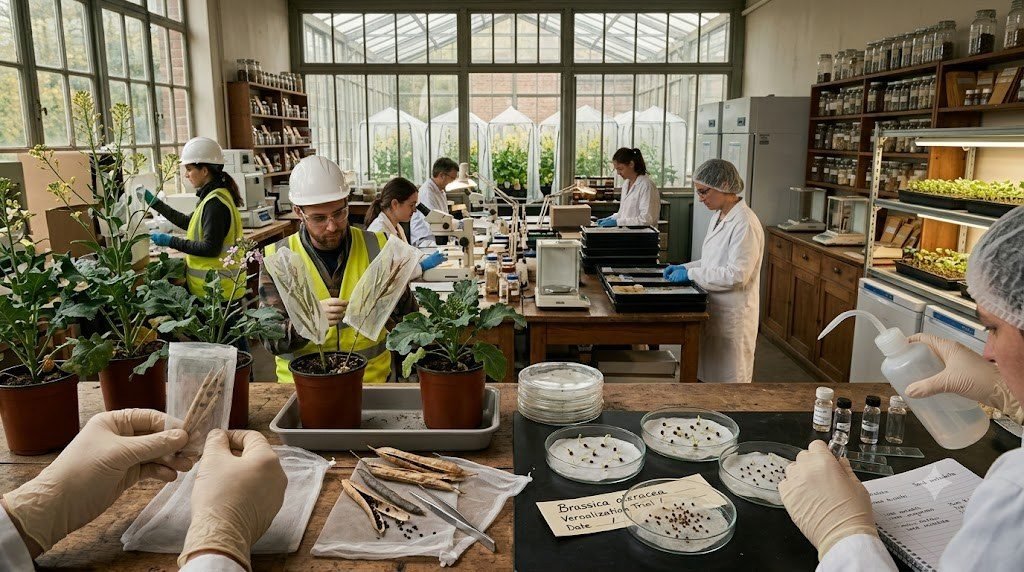
Following insect cross-pollination by honeybees and native syrphid flies, brassica flowers develop elongated, two-valved seed capsules termed siliques. As siliques mature over 60 to 80 days, their chlorophyll degrades, turning from bright green to golden parchment tan.
The single greatest operational hazard during brassica seed harvesting is pod shatter. When siliques dry fully on the standing plant, the slightest wind gust or mechanical vibration triggers dehiscence: the outer pod carpels snap open along the replum suture line, ejecting hundreds of viable seeds onto the soil. Savvy growers cut entire seed stalks when approximately 60% to 70% of the lower siliques have turned light brown, laying the stalks over breathable canvas tarps inside an airy barn to cure and after-ripen without seed loss before threshing.
The Molecular Genetics of FLC and Epigenetic Vernalization Memory
The transition of a biennial brassica plant from a leafy vegetative rosette into a bolting, flowering seed head is governed by a sophisticated epigenetic molecular circuit centered on the FLOWERING LOCUS C (FLC) gene. In first-year cabbage and kale plants, the FLC gene encodes a powerful MADS-box transcription factor that acts as a dominant floral repressor, binding to promoter regions of floral integrator genes (such as FT and SOC1) and completely silencing flower initiation.
During the 8 to 12 weeks of winter chilling (2°C to 6°C), plant cells transcribe a non-coding antisense RNA transcript termed COOLAIR. The accumulation of COOLAIR recruits histone methyltransferase enzyme complexes that chemically modify the chromatin architecture surrounding the FLC locus, adding repressive trimethylation marks to histone H3 lysine 27 (H3K27me3). This stable epigenetic modification silences the FLC repressor permanently: when warm spring temperatures return, the repression is gone, enabling the rapid surge of floral initiation hormones and massive stem elongation.
🌱 Self-Incompatibility (SI) and the S-Locus Receptor Kinase
Brassicas are obligate cross-pollinators possessing a sporophytic self-incompatibility (SSI) system governed by the polymorphic S-locus. If pollen from a flower lands on its own stigma, proteins encoded by the SCR/SP11 gene in the pollen coat bind to the SRK receptor kinase on the stigma papilla cells. This initiates an intracellular signaling cascade that blocks pollen hydration and inhibits pollen tube penetration, preventing self-fertilization. Consequently, saving healthy brassica seed requires maintaining a minimum breeding population of at least 20 to 50 individual mother plants to avoid severe inbreeding depression.
Spatial Isolation Geometry and Pollen Dispersal Vectors
Because brassica pollen is dry, light, and transported over immense distances by wind and foraging pollinating insects, isolation distances must be rigorously enforced. Commercial organic seed certification standards mandate:
| Breeding & Purity Tier | Minimum Spatial Isolation Distance | Physical Screening Alternative | Applicable Seed Category |
|---|---|---|---|
| Foundation / Elite Seed | 1.6 km (1.0 mile) open distance. | Insect-proof screening cages with introduced bumblebee hives. | Preservation of heirloom landraces and foundation breeding stocks. |
| Certified Seed Standard | 800 meters (½ mile) open distance. | Isolation by distance in rural agricultural valleys. | Commercial open-pollinated seed production. |
| Home Garden Standard | 400 meters (¼ mile) minimum. | Staggered bloom timing or hand-pollinated isolation tents. | Backyard seed saving with acceptable 1%-2% off-type tolerance. |
Silique Dehiscence Tension and Suture Zone Lignification
As brassica silique pods dry, differential cell contraction generates intense mechanical strain across the pod carpel walls. The dehiscence zone consists of a narrow strip of non-lignified separation cells bounded by heavily lignified valve margins. As internal moisture drops below 12%, differential shrinkage causes the separation cells to rupture catastrophically along the replum margin. Harvesting timing is optimized by monitoring the dehiscence zone: when pods flex slightly without popping, cut the seed stalks in the cool early morning when ambient humidity is highest to prevent field shatter.
Regulatory Standards, ISTA Protocols, and Seed Certification
The commercial distribution and genetic conservation of vegetable seed stocks are governed by comprehensive international and national legal standards. In the United States, the Federal Seed Act (7 U.S.C. 1551) and individual state seed laws enforce minimum germination standards, noxious weed seed tolerances, and varietal trueness labeling. Internationally, the International Seed Testing Association (ISTA) and the Association of Official Seed Analysts (AOSA) publish standardized laboratory protocols for measuring seed purity, moisture content, and germination percentages.
For commercial certified seed production, seed lots must satisfy rigorous four-tier certification standards established by the Association of Official Seed Certifying Agencies (AOSCA):
- Breeder Seed: The highest genetic tier, directly controlled by the originating plant breeder or university agricultural experiment station, guaranteeing 100% varietal purity.
- Foundation Seed: Produced from breeder seed and maintained by agricultural universities or foundation seed organizations under maximum spatial isolation.
- Registered Seed: The progeny of foundation seed, carefully managed to maintain satisfactory genetic identity and purity for commercial multiplication.
- Certified Seed: The final commercial tier sold to farmers and home growers, certified to meet statutory minimum germination percentages (typically ≥ 75% for cucurbits and legumes; ≥ 80% for tomatoes and brassicas) and zero tolerance for designated noxious weed seeds.
Seed Health, Phytosanitary Testing, and Pathogen Exclusion
Seed-borne plant pathogens—including bacterial canker (Clavibacter in tomatoes), black rot (Xanthomonas campestris in brassicas), and anthracnose (Colletotrichum in beans)—can devastate entire agricultural regions if infected seed lots are shipped across borders. Certified seed laboratories deploy molecular diagnostic testing—including Polymerase Chain Reaction (PCR) assays, enzyme-linked immunosorbent assays (ELISA), and agar plating—to verify that seed lots are certified pathogen-free prior to issuing USDA-APHIS phytosanitary export certificates.
| Crop Family | Primary Seed-Borne Pathogen | Diagnostic Assay | Sanitation / Quarantine Benchmark |
|---|---|---|---|
| Solanaceae (Tomatoes) | Clavibacter michiganensis (Bacterial Canker) | Immunofluorescence / PCR | Zero tolerance; 48-hr fermentation or hot water treatment at 50°C for 25 min. |
| Brassicaceae (Cabbage/Kale) | Xanthomonas campestris (Black Rot) | Liquid plating on mCS20AB media | Zero tolerance; hot water treatment at 50°C (122°F) for 20 minutes. |
| Cucurbitaceae (Melons/Squash) | Acidovorax citrulli (Bacterial Fruit Blotch) | Seedling grow-out PCR assay (30,000 seeds) | Zero visual symptoms in 30,000 seedling greenhouse grow-out test. |
| Fabaceae (Beans/Peas) | Pseudomonas savastanoi (Halo Blight) | Agar dilution plating | Field roguing of infected plants; seed harvest strictly from disease-free fields. |
Technical Frequently Asked Questions (FAQ)
Why is hot water seed treatment recommended for brassica and tomato seeds?
Hot water treatment is a non-chemical thermotherapeutic protocol that eradicates internal and external seed-borne bacterial pathogens (such as bacterial canker, black rot, and bacterial spot) without harming seed viability. Seeds are submerged in precisely calibrated hot water (50°C / 122°F) for 20 to 25 minutes using a thermostatically controlled circulating water bath. The heat penetrates the seed coat, denaturing bacterial proteins while remaining just below the thermal death threshold of the plant embryo. Water temperatures must be monitored with ±0.5°C precision, as higher temperatures kill the embryo and lower temperatures fail to eliminate bacteria.
What is the difference between open-pollinated, heirloom, and F1 hybrid seeds?
Open-pollinated (OP) varieties are pollinated by natural mechanisms (wind, insects, or selfing) and breed true-to-type, producing offspring identical to the parent generation if isolated from crossing. An heirloom is an open-pollinated variety that possesses historic provenance, having been preserved, selected, and handed down through families, ethnic communities, or indigenous tribes for at least 50 years. An F1 hybrid is the first-generation offspring of an intentional cross between two highly inbred parent lines. F1 hybrids exhibit hybrid vigor (heterosis) in their first year, but their saved seeds segregate into genetically unpredictable, inferior wild forms in the second (F2) generation, making them unsuitable for seed saving.
How long do vegetable seeds remain viable in typical home storage?
Seed longevity depends on the botanical crop family and environmental storage conditions. Under standard cool, dark, dry room conditions (20°C and 40% relative humidity): Alliums (onions, leeks) and sweet corn have the shortest lifespan, remaining viable for only 1 to 2 years. Brassicas, carrots, and lettuce maintain good germination for 3 to 4 years. Solanaceous crops (tomatoes, peppers, eggplants), legumes (beans, peas), and cucurbits (squash, melons, cucumbers) are long-lived, routinely retaining high germination for 5 to 6+ years. Placing orthodox seeds in airtight glass jars with desiccants in a sub-zero freezer extends viability to 20 to 40+ years.
How can home seed savers prevent inbreeding depression in cross-pollinated crops?
Cross-pollinating (allogamous) crops—such as corn, cabbage, carrots, and onions—require a genetically diverse breeding population to maintain biological vigor. If a gardener saves seeds from only two or three individual cabbage plants year after year, recessive deleterious mutations accumulate, leading to severe inbreeding depression: stunted growth, reduced yields, loss of heading ability, and poor germination. To preserve genetic vigor, seed savers adhere to minimum population size rules: save seeds from at least 20 to 50 individual mother plants for brassicas and squashes, and at least 100 to 200 individual plants for wind-pollinated sweet corn.
Glucosinolate Allelopathy and Pollinator Synergy in Flowering Brassica Stands
When biennial brassicas bolt into bloom during their second spring season, the planting transforms from a culinary vegetable patch into an ecological super-attractor for native beneficial insects. A blooming stand of 30 to 50 heirloom cabbage or kale mother plants produces millions of nectar-rich yellow cruciform blossoms emitting aromatic floral volatiles that draw swarms of solitary sweat bees, bumblebees, and predatory syrphid flies. These beneficial insects provide vital ecological pollination services while parasitizing emerging garden aphids.
Simultaneously, senescing brassica root systems exude high concentrations of glucosinolates into the surrounding soil. When broken down by soil microbial myrosinase enzymes, glucosinolates hydrolyze into potent natural bio-fumigants (isothiocyanates) that suppress destructive soil-borne nematode populations and verticillium wilt fungi. By completing their full biennial seed lifecycle, brassica mother plants dramatically improve soil health and biological pest resilience for subsequent crop rotations.
In addition, maintaining diverse brassica seed accessions protects rare traits such as cold-tolerance glucosinolate profiles, thick protective leaf waxes, and resistance to clubroot (Plasmodiophora brassicae), ensuring that organic growers retain robust genetic tools as regional climates become increasingly unpredictable.